
 October 9, 2026
 0 comments

Under obviousness-type double patenting (ODP), the claims of your own earlier patent or co-pending application can make the claims of a later patent unpatentable or invalid, even though your own patent is not prior art under Sections 102 or 103. The test is whether the two sets of claims are “patentably distinct.” If the later claims would have been obvious over the earlier claims, the later patent is exposed. The doctrine exists for one reason: no invention gets a second, later-expiring term.
For a portfolio manager, the stakes are quiet ones. A continuation that looks healthy on the docket may already be tied to a sibling by a terminal disclaimer, may have picked up patent term adjustment that makes it a target, or may have been sold in a carve-out that broke common ownership. None of it shows until an acquirer or a litigant looks.
Key Takeaways
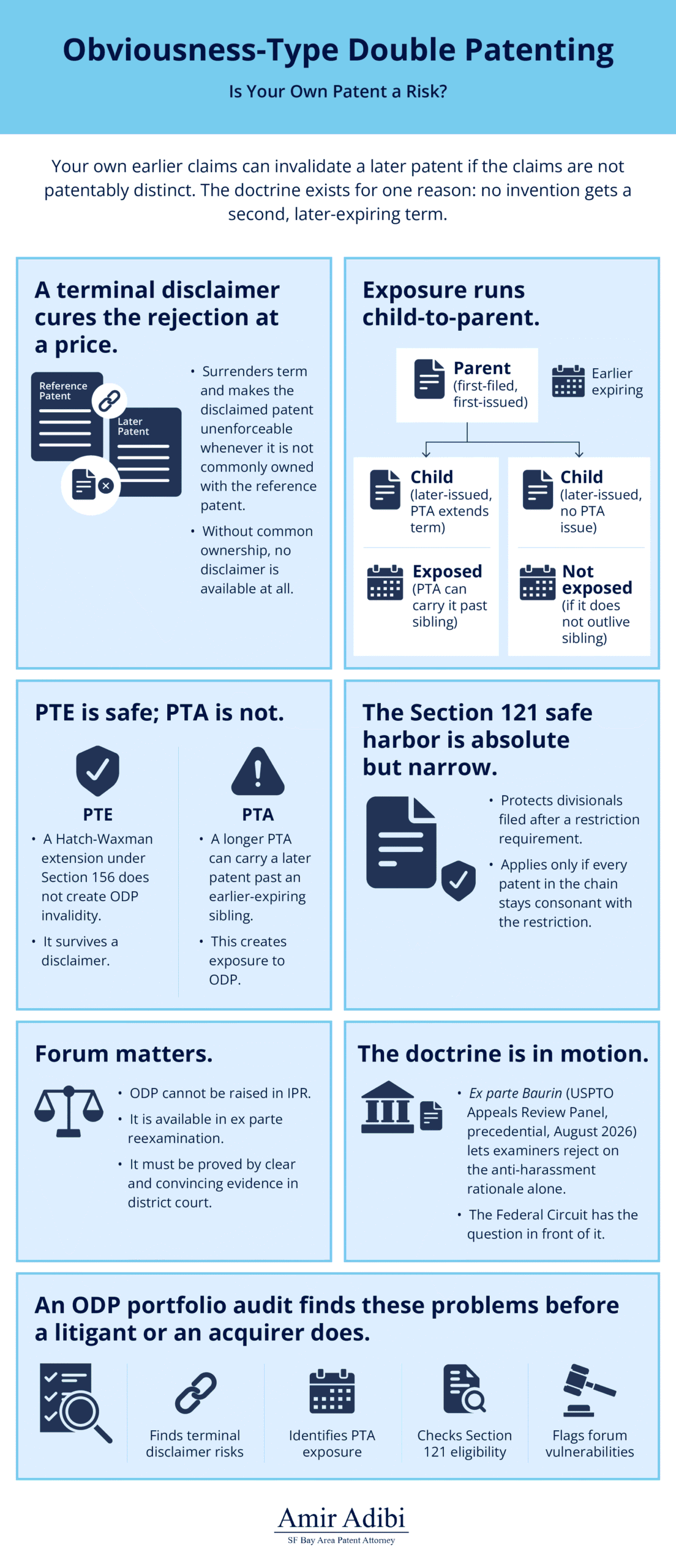
- A terminal disclaimer cures the rejection at a price. It surrenders term and makes the disclaimed patent unenforceable whenever it is not commonly owned with the reference patent. Without common ownership, no disclaimer is available at all.
- Exposure runs child-to-parent. Under In re Cellect (Fed. Cir. 2023) and Allergan USA v. MSN Laboratories (Fed. Cir. 2024), a later-issued child whose PTA carries it past an earlier-expiring sibling is exposed; a first-filed, first-issued parent is not.
- PTE is safe; PTA is not. A Hatch-Waxman extension under Section 156 does not create ODP invalidity, and it survives a disclaimer.
- The Section 121 safe harbor is absolute but narrow. It protects divisionals filed after a restriction requirement, as long as every patent in the chain stays consonant with the restriction.
- Forum matters. ODP cannot be raised in IPR, is available in ex parte reexamination, and must be proved by clear and convincing evidence in district court.
- The doctrine is in motion. Ex parte Baurin (USPTO Appeals Review Panel, precedential, August 2026) lets examiners reject on the anti-harassment rationale alone, and the Federal Circuit has the question in front of it.
- An ODP portfolio audit finds these problems before a litigant or an acquirer does. It finds terminal disclaimer risks, identifies PTA exposure, checks Section 121 eligibility, and flags forum vulnerabilities.
Understanding the Legal Foundation of Obviousness-Type Double Patenting
The Core Legal Standard: What “Not Patentably Distinct” Actually Means
Obviousness-type double patenting (ODP) is a judicially created doctrine that stops a patentee from obtaining a second patent on claims that are obvious variants of claims in an earlier patent or application, so that one invention does not receive two terms. It is also called non-statutory double patenting, to distinguish it from statutory double patenting under Section 101, which bars two patents on the same invention. Statutory double patenting is rare and easy to spot. ODP is neither.
The default test is one-way. The examiner, or a court, asks whether the later claims would have been obvious over the earlier claims. The Graham factors from the obviousness analysis framework apply, but the comparison is claim-to-claim rather than claim-to-prior-art. The reference patent’s specification is used only to construe its claims; it cannot supply teachings the claims do not contain (General Foods v. Studiengesellschaft Kohle, Fed. Cir. 1992). An examiner who reads the parent’s examples into the parent’s claims is over-reaching, and the argument is worth making.
One consequence portfolio managers often miss: because the reference is a claim and not a disclosure, an ODP reference can be a patent that issued after the subject patent but expires earlier (Gilead Sciences v. Natco Pharma, Fed. Cir. 2014). Issue order does not protect you. Expiration order does the work.
| Factors | Section 103 obviousness | Obviousness-type double patenting |
| Comparison basis | Claims versus prior art as a whole | Claims versus the claims of the reference patent |
| Source of reference | Any prior art under Section 102 | Your own patent or co-pending application |
| Cure | Amend or argue only | Amend, argue, or disclaim term |
| Effect of cure | None on term | Disclaimer surrenders term and requires common ownership |
Why ODP Exists: The Two Policy Concerns Courts Protect
Courts cite two concerns. The first is unjustified extension of term: a patentee should not stretch exclusivity on one invention by filing obvious variants that expire later. The second is harassment: if obvious variants of one invention could be split among different owners, an accused infringer could face serial suits over what is functionally a single patent. The harassment concern is why the disclaimer carries a common-ownership condition, discussed below.
The second concern is now doing more work than it used to. In Ex parte Baurin (USPTO Appeals Review Panel, precedential, August 2026), the Office reinstated ODP rejections and held that, under existing Federal Circuit precedent, the anti-harassment rationale alone supports a rejection even where the later patent would not extend the family’s expiration at all. The panel said it would welcome clarification from the Federal Circuit on that point. Until it comes, matching expiration dates do not eliminate ODP risk during examination.
The next section turns the standard into a procedure you can run against a real family.
Conducting a Rigorous ODP Analysis: A Step-by-Step Framework
Identifying the Reference Patent and Subject Patent in an ODP Rejection
The subject patent is the one under attack. The reference patent supplies the claims the subject patent is compared against. The reference can be an issued patent or a co-pending application; in the second case, the examiner issues a provisional ODP rejection under MPEP § 804. If that provisional rejection is the only one left in the application with the earlier patent term filing date, the Office withdraws it and allows that application (MPEP § 804(I)(B)(1)), pushing the ODP problem into the later-filed one. Practitioners who understand that sequence can choose which application takes the disclaimer.
The analysis is claim-by-claim, and a simple chart does the work:
| Subject claim | Closest reference claim | Element-by-element difference | Obvious over reference claim? | Response |
| 1 | Reference patent, claim 1 | Adds “wherein the coating is polymeric” | Likely yes | Argue, amend, or disclaim |
| 5 | Reference patent, claim 4 | Different mechanism of action | Arguably no | Argue distinctness |
Applying the One-Way and Two-Way Obviousness Tests
The one-way test is the default: are the subject claims obvious over the reference claims? The two-way test, which also asks whether the reference claims are obvious over the subject claims, is a narrow exception. It applies only where the Office’s handling, and not the applicant’s prosecution choices, caused the later-filed claims to issue first (In re Braat, Fed. Cir. 1991; In re Berg, Fed. Cir. 1998). An applicant who could have filed both sets of claims in one application does not get the benefit.
Which test applies?
- Were the two sets of claims filed at different times? If not, one-way.
- Did the later-filed claims issue first? If not, one-way.
- Was that ordering caused by the Office’s delay rather than by the applicant? If not, one-way.
- Only if all three answers are yes does the two-way test apply.
Common Claim Configurations That Trigger ODP Rejections
| Configuration | Why it triggers ODP | Usual response |
| Genus in the parent, species in the child (or the reverse) | A species is usually obvious over a claimed genus; a close genus is often obvious over a claimed species.. | Show unexpected properties; otherwise disclaim. |
| Compound claim in the parent, method-of-use claim in the child | A later claim to a use that is the natural result of practicing what the parent already claims adds nothing patentably distinct; Eli Lilly v. Barr (Fed. Cir. 2001) reached that result where a later method claim was inherent in an earlier method-of-treatment claim. | Argue an unexpected use; otherwise disclaim. |
| Added dependent limitation that is itself obvious | A routine limitation does not create distinctness. | Amend to a non-obvious limitation. |
| Continuation claims that broaden slightly | Dropping one element from a parent claim produces a genus that reads on the parent’s species. | Argue the dropped element was critical; otherwise disclaim. |
Take the last row. The parent claims a stent with a drug-eluting polymer coating; the continuation claims the same stent with “a coating.” The continuation is a genus that swallows the parent’s species, and the examiner will treat it as obvious over the parent’s claim.
Once the analysis shows a real conflict, the question becomes how to cure it, and the primary tool has a price.
Terminal Disclaimers: The Primary Weapon Against ODP Rejections
How a Terminal Disclaimer Overcomes an ODP Rejection
A terminal disclaimer works by surrendering any term of the subject patent that would run past the expiration of the reference patent, so the two expire together and the term-extension concern disappears. It does not concede that the claims are obvious (Quad Environmental v. Union Sanitary District, Fed. Cir. 1991). It can be filed during prosecution, after issuance, and during litigation.
Under 37 C.F.R. § 1.321(c)(3), a disclaimer filed to obviate ODP must also state that the subject patent is enforceable only while it and the reference patent are commonly owned. That one condition is the source of nearly every downstream problem in this article.
One timing rule with teeth: a disclaimer cannot retroactively cure ODP once the earlier reference patent has expired (Boehringer Ingelheim v. Barr Laboratories, Fed. Cir. 2010). A patentee who waits until the reference patent has expired has no cure left.
The Common-Ownership Requirement: Hubbell and the Enforceability Consequence
There are two separate risks, and they are often conflated.
The first arises before any disclaimer is filed. In In re Hubbell (Fed. Cir. 2013), the reference and subject applications shared inventors but not owners. The court held that no disclaimer was available, because there was no common ownership to condition it on, so the rejection could not be cured. Joint development, university collaborations and inventors moving between companies all produce this fact pattern.
The second arises after a disclaimer is filed. Because of the § 1.321(c) condition, the disclaimed patent is unenforceable during any period in which it is not commonly owned with the reference patent. The reference patent itself is unaffected. What breaks common ownership is not exotic: a partial sale of a family, a spin-out that takes some assets, an exclusive license structured as an assignment, an unrecorded transfer.
Consider a medtech company that disclaims term in a continuation covering its best-selling device to overcome a rejection over the parent. Five years later it sells the parent’s product line, and the parent patent with it, to a buyer who wants the legacy business. The continuation stays behind. Nobody checks the disclaimer. When the company later sues a competitor on the continuation, the defendant’s first motion says the asserted patent has been unenforceable since the day the parent changed hands. The patent looked healthy on every docket report.
| Transaction type | Effect on a disclaimer-linked patent |
| Sale of the entire family to one buyer | Common ownership preserved, no effect |
| Sale of some family members | Disclaimed patents left behind become unenforceable while ownership is split |
| Exclusive license (no assignment) | Ownership unchanged, typically no effect, but check the license terms |
| Spin-out or carve-out of a business unit | Same as a partial sale, audit every linked patent before closing |
| Joint venture or co-development | May prevent a disclaimer from being filed at all (Hubbell) |
Strategic Considerations Before Filing a Terminal Disclaimer
Practitioners typically run this checklist before filing:
- Argue or amend first where the claims are distinct on the merits; a disclaimer is permanent.
- Quantify the term surrendered, including any PTA the subject patent has accrued.
- Map the web of linked expirations in multi-continuation families; one disclaimer can tie a chain of patents to its shortest-lived member.
- Confirm that every patent in the chain is, and will remain, commonly owned.
- Document the business rationale so that diligence teams later understand why it was filed.
Not sure which of your patents are linked by terminal disclaimers? Request a portfolio review.
Before a family reaches the point where a disclaimer is the only option, the choice between a continuation and a divisional often decides whether the problem exists at all.
Continuations Versus Divisionals: Choosing the Filing Path That Limits ODP Exposure
The divisional-versus-continuation question is among the most common practical questions in this area, and it is also the one with the clearest rule. Section 121 protects a divisional filed as a result of a restriction requirement: the parent cannot be used as an ODP reference against it. An ordinary continuation receives no such protection: the safe harbor is limited to divisionals (Pfizer v. Teva, Fed. Cir. 2008, addressing a continuation-in-part), and a continuation is not a divisional (Amgen v. Hoffmann-La Roche, Fed. Cir. 2009). A continuation of a divisional keeps the protection, but only if its claims remain consonant with the restriction (Amgen).
| Filing type | Section 121 available | ODP exposure | Typical use | Key case |
| Continuation | No | Full | Broader or different claims to the same disclosed invention | Amgen v. Roche (2009) |
| Divisional after restriction | Yes, if consonant | None as to the parent | A non-elected invention | Pfizer v. Teva (2008) |
| Continuation of a divisional | Yes, if consonance maintained | None as to the parent while consonant | Further claims within the non-elected group | Amgen v. Roche (2009) |
| Continuation-in-part | No | Full for claims supported by the parent | New matter | Pfizer v. Teva (2008) |
| Voluntary “divisional” with no restriction | No | Full | A mislabeled continuation | Geneva v. GSK (2003) |
The practical rule: a divisional is only a divisional if the Office restricted first. The label on the filing changes nothing.
Even a well-chosen filing path can be undone by the term the Office adds for its own delays.
Patent Term Adjustment, Patent Term Extension and Their Interaction With ODP
How Patent Term Adjustment Creates Hidden ODP Exposure
Patent term adjustment (PTA) under 35 U.S.C. § 154(b) compensates the patentee for Office delay by adding days to the twenty-year term. Because delays vary by application, siblings that share a priority date end up with different expiration dates. A child that receives eighteen months of PTA expires eighteen months after a parent that received none. That gap is where obviousness-type double patenting lives.
In re Cellect and Allergan v. MSN: The Current Rule for PTA-Extended Patents
In re Cellect (Fed. Cir. 2023; cert. denied Oct. 7, 2024) held that ODP is measured against the expiration date including PTA, and that PTA does not shield a patent from the doctrine. Later-expiring family members with PTA were found unpatentable over a sibling with none. The natural reading was alarming: any patent with PTA looked vulnerable to any sibling without it.
Allergan USA v. MSN Laboratories (Fed. Cir. 2024) narrowed that reading. A first-filed, first-issued patent cannot be invalidated for ODP by a later-filed, later-issued family member sharing a common priority date, even if PTA makes the first patent expire later, because the first patent does not extend any exclusivity the later one created.
So does PTA survive ODP? Yes for a first-filed, first-issued patent; no for a later-issued child whose PTA carries it past an earlier-expiring sibling that is a proper reference. Exposure runs from later-issued children with PTA toward earlier parents, not the reverse.
Two cautions. First, the Office reads Allergan narrowly in examination. Ex parte Baurin (ARP, August 2026) limits the exception to a patent that is first-filed in the family, first-issued, and shares a patent term filing date with the reference. Outside that pattern, examiners continue to reject, and disclaiming accrued PTA may be the only cure. Second, the USPTO’s May 2024 proposed rule, which would have made a disclaimed patent unenforceable if any claim of the reference patent fell, was withdrawn on December 4, 2024 after more than 300 comments, and no later Federal Register notice has revived it.
For older families: a pre-1995 patent whose term runs seventeen years from issue cannot be invalidated by a post-1995 family member that expires earlier, because that gap is a product of the statutory transition rather than gamesmanship (Novartis v. Breckenridge, Fed. Cir. 2018).
Patent Term Extension Under Hatch-Waxman and Its Relationship to ODP
Patent term extension (PTE) under 35 U.S.C. § 156 restores term lost to regulatory review of a drug, biologic or device, and it is treated differently from PTA. In Novartis v. Ezra (Fed. Cir. 2018), the court held that a patent extended under Section 156 is not invalid for ODP merely because the extension pushes its expiration past a later-expiring family member. And a disclaimer caps only the base term; PTE can extend beyond that disclaimed date (Merck v. Hi-Tech Pharmacal, Fed. Cir. 2007).
| Factor | Patent term adjustment | Patent term extension |
| Statute | 35 U.S.C. § 154(b) | 35 U.S.C. § 156 |
| Cause compensated | USPTO examination delay | FDA regulatory review |
| Applies to | Any patent | One patent per regulatory review period for a product, chosen by the owner (§ 156(c)(4)) |
| ODP treatment | Counted in the expiration date, child with PTA is exposed | Not a basis for ODP invalidity |
| Effect of a disclaimer | Surrenders the PTA | Caps the base term, PTE still extends beyond it |
| Controlling case | Cellect (2023), Allergan v. MSN (2024) | Novartis v. Ezra (2018), Merck v. Hi-Tech (2007) |
For a life-sciences business developer, the exclusivity runway is not the date on the docket. It is the base term, less any disclaimer, plus PTE on the one patent that received it.
Have PTA-extended continuations? Ask for a Cellect exposure assessment.
Where a family was built on restriction requirements, a statutory shield may make all of this moot. The shield is narrower than most portfolio managers assume.
The Section 121 Safe Harbor: A Powerful but Narrow Defense
What the Section 121 Safe Harbor Provides and When It Applies
35 U.S.C. § 121 provides that, once the Office has imposed a restriction requirement, the original application and any divisional filed as a result of it cannot be used as references against each other. The logic is fairness: the Office forced the applicant to split the inventions, so the Office cannot then punish the split. Three conditions apply. The Office must actually have imposed a restriction; the divisional must have been filed as a result of it; and the claims must stay consonant with the lines the restriction drew.
The Consonance Requirement: How Practitioners Lose Section 121 Protection
Consonance means that every patent in the chain, the challenged patent and the reference patent alike, honors the line the examiner drew between the restricted inventions, and does not reach back into the elected group or straddle the line. Crossing the line forfeits the safe harbor (Geneva Pharmaceuticals v. GlaxoSmithKline, Fed. Cir. 2003; St. Jude Medical v. Access Closure, Fed. Cir. 2013).
| Consonance preserved | Consonance lost |
| Restriction separates Group I (compound) from Group II (method of treatment). Applicant elects Group I and files a divisional claiming only the method. The parent cannot be a reference. | Restriction separates Group I (device) from Group II (method), and the examiner also divides each group into Species A, B and C. A continuation descended from the divisional claims the device and the method of Species C. A sibling continuation claims a Group II method generic to every species. The sibling’s generic claim overlaps the Species C method, the line of demarcation is not maintained, and the safe harbor falls away for both. |
St. Jude is the second column in practice. The Janzen patent, a continuation of a divisional, claimed device and method claims to one species; its sibling claimed a method generic to all species. Because the sibling’s claim overlapped what Janzen claimed, consonance was broken across the family, the safe harbor did not apply, and the Janzen claims were invalid for double patenting over the sibling. Consonance is tested on every patent in the chain, including the one used as the reference.
Documenting the Restriction History to Preserve the Safe Harbor
Consonance is proved from the file history. Practitioners typically build a short map for every family that relies on Section 121: the restriction requirement and its groups, any election of species, the election and any traverse, the filing date and parentage of each divisional, and every later amendment checked against the group boundaries. That map belongs in the family’s ODP risk register, introduced in the portfolio section below.
When prevention fails, ODP becomes a litigation question, and it behaves differently in each forum.
ODP in Patent Litigation and Post-Grant Proceedings
Raising ODP as a Patent Defense in Infringement Litigation
Obviousness-type double patenting is an invalidity defense. The issued patent carries the Section 282 presumption of validity on every ground, so a defendant must prove ODP by clear and convincing evidence, the same standard as any other invalidity theory in district court (Procter & Gamble v. Teva, Fed. Cir. 2009). A patent defense built on ODP usually pairs a claim chart mapping the asserted claims onto the reference claims with an expert opinion that the differences would have been obvious.
A patentee can disclaim term after issuance and even during litigation, so long as the reference patent has not yet expired (Boehringer). That fixes the going-forward problem. Whether damages survive for infringement that occurred while the patent was in an ODP-invalid state is a question the Federal Circuit has not squarely answered, and any PTA surrendered is gone.
ODP in Inter Partes Review, Post-Grant Review and Reexamination
Can ODP be raised in IPR? No. Inter partes review is limited by 35 U.S.C. § 311(b) to Section 102 and 103 grounds based on patents and printed publications, and ODP is neither. Post-grant review is broader: 35 U.S.C. § 321(b) allows any ground under Section 282(b)(2) or (3), but no Federal Circuit decision has settled whether that reaches ODP, so its availability in PGR remains unsettled. It is available in ex parte reexamination, which is how Cellect reached the Federal Circuit. Defendants therefore often run two tracks: prior art in IPR, ODP in district court or reexamination.
Key Federal Circuit Precedents for ODP Practitioners
| Case | Year | Holding in one line | Why it matters to a portfolio manager |
| In re Longi | 1985 | One-way test, ODP prevents unjustified term extension. | The baseline test for every rejection. |
| In re Braat | 1991 | Two-way test where Office delay caused the ordering. | The exception is narrow. |
| In re Berg | 1998 | Two-way test unavailable where applicant controlled the ordering. | Filing choices decide which test applies. |
| Eli Lilly v. Barr | 2001 | Later method claim inherent in an earlier claimed method is not patentably distinct. | Closely related method claims in one family are exposed. |
| Geneva v. GSK | 2003 | Section 121 requires an actual restriction and consonance. | Labels do not create a divisional. |
| Pfizer v. Teva | 2008 | Section 121 is limited to divisionals; a CIP is unprotected. | Ordinary continuations and CIPs are outside the harbor. |
| Amgen v. Roche | 2009 | A continuation is not a divisional, but a continuation of a divisional keeps Section 121 if consonant. | Chains from a divisional can stay protected. |
| In re Hubbell | 2013 | No disclaimer without common ownership. | Collaborations can leave rejections incurable. |
| Gilead v. Natco | 2014 | Later-issued, earlier-expiring patent can be a reference. | Issue order does not protect a patent. |
| Novartis v. Ezra | 2018 | PTE-extended patent not invalid merely for expiring later. | PTE is safe; PTA is not. |
| In re Cellect | 2023 | ODP measured with PTA included. | PTA-extended children are exposed. |
| Allergan v. MSN | 2024 | First-filed, first-issued patent cannot be invalidated by a later sibling with a common priority date. | Exposure runs child-to-parent, not parent-to-child. |
Knowing the cases is the litigation view. Preventing the litigation is the portfolio view.
Strategic Portfolio Management to Prevent and Mitigate ODP Risk
Building an ODP-Resilient Prosecution Strategy From Day One
Practitioners who manage continuation-heavy families typically do three things before each new filing. They plan claim differentiation, drafting each continuation’s claims to be patentably distinct from every issued and pending sibling, not just the immediate parent. They draw restriction requirements deliberately where a divisional path is wanted, by filing claim sets that plainly cover more than one invention, so that Section 121 attaches. And they keep a living ODP risk register per family that records every disclaimer, every PTA award, every restriction and every ownership change.
Auditing Existing Portfolios for Hidden ODP Vulnerabilities
An existing portfolio needs a different approach, because the decisions have already been made. A patent portfolio analysis aimed at ODP typically follows eight steps:
- Map every family tree, including abandoned and pending applications, with filing, issue and expiration dates.
- Record PTA and PTE for every member; flag any child that expires after a parent.
- Pull every terminal disclaimer from the file histories and chart which patents it links.
- Cross-reference the linked patents against current assignment records to confirm common ownership today.
- Compare claims across siblings for patentable distinctness, starting with the families that generate revenue.
- Identify every divisional, confirm the restriction it responded to, and test consonance against the group boundaries.
- Apply the Cellect and Allergan rule: list later-issued children with PTA whose siblings are proper references.
- Rank the exposed patents by commercial value and decide, family by family, whether to argue, amend, disclaim or accept the risk.
Managing ODP Risk During Mergers, Acquisitions and Patent Transactions
Deal counsel see the consequences of everything above, usually late. A pre-closing diligence protocol for ODP typically includes:
- A schedule of every disclaimer in the target portfolio and the patents each one links.
- Confirmation that no linked patent is being left behind, carved out or licensed in a way that splits ownership.
- Representations and warranties that all disclaimers are disclosed, that common ownership has been continuous since each was filed, and that no ODP rejection was overcome by a disclaimer that is now unavailable.
- A list of PTA-extended children and their proper references under the Cellect and Allergan rule.
- A post-closing protocol assigning responsibility for keeping linked patents commonly owned through any later restructuring.
Where a partial-family transfer is unavoidable, practitioners typically restructure it: move the whole family and license back what the seller needs, or keep the whole family and license out what the buyer needs.
Emerging Developments and the Future of Obviousness-Type Double Patenting
Legislative and Regulatory Pressure After In re Cellect
Since Cellect, the pressure has fallen on the Office and the courts rather than Congress. The USPTO’s May 2024 proposed rule was withdrawn in December 2024 after strong opposition. In August 2026, the Office’s Appeals Review Panel issued Ex parte Baurin as precedential, reaffirming that anti-harassment alone can support a rejection while saying it would welcome clarification from the Federal Circuit; the decision itself notes that the same question is pending before that court in a separate appeal, In re Ablynx N.V., No. 26-1333. Reform proposals in the academic and bar literature run from abolishing the anti-harassment rationale to tightening disclaimer practice further.
How U.S. ODP Compares to Double Patenting Rules in Other Jurisdictions
Obviousness-type double patenting is not unique to the United States, but the U.S. version is unusually broad and entirely judge-made. A terminal disclaimer has no effect outside the United States.
| Jurisdiction | Double patenting rule | Practical effect |
| United States | Judicially created ODP, claims compared for obviousness, cured by disclaiming term | Broadest doctrine, continuation families are the main exposure |
| European Patent Office | No obviousness-type doctrine, same-subject-matter double patenting may be refused (Enlarged Board decision G 4/19, 2021), overlap otherwise policed through unity of invention and opposition | Obvious variants generally coexist, no term linkage |
| Japan | Statutory bar on a second patent for an identical invention, including one filed by the same applicant (Patent Act Article 39) | Identity, not obviousness, is the test |
| Canada | Judicially recognized double patenting, including an obviousness-type branch (Whirlpool v. Camco, SCC 2000, as applied by the Patent Appeal Board) | Closest to the U.S. approach, without disclaimers |
Sectors Facing the Next Wave of ODP Challenges
Pharma and biotech remain the primary battleground because compound, formulation, method and dosing claims are naturally close variants and the exclusivity is worth litigating. AI and software portfolios are next: rapid iteration produces dense continuation chains with incremental claim differences. Medical device and semiconductor families share the same profile, with one added complication: product-line divestitures are common, and they quietly break common ownership.
Your Next Step: An ODP Audit Before Someone Else Runs One
Your own earlier claims can defeat your later patent under obviousness-type double patenting, and three levers decide whether they do: patentable distinctness, the terminal disclaimer and its ownership condition, and the Section 121 safe harbor. Each lever has a case behind it, a rule that follows from the case, and a consequence for the docket. Three questions tell you whether your portfolio is ready for scrutiny:
- Do you know every terminal disclaimer in your portfolio and which patents each one links?
- Which of your children received PTA, and are their siblings proper references?
- Which of your divisionals are still consonant with the restrictions that created them?
If any answer is uncertain, a patent portfolio analysis focused on ODP is overdue. Schedule an ODP portfolio audit before a litigant or acquirer runs one for you.