
 September 7, 2026
 0 comments
A Markush group is a claim construction that lets one patent claim cover an entire family of related compounds by listing the permitted alternatives at defined positions on a core structure, using the phrase “selected from the group consisting of.” That formula sets the legal boundary of the property. The examples in the specification do not.
The boundary can enclose millions of theoretical compounds, which makes it the most valuable and the most attackable element of a chemical patent. It fails in two directions. Drafted too broadly, it collapses under written description, enablement or indefiniteness challenge. Cleared by text search alone, it hides, because a keyword search cannot retrieve a compound that a prior art claim covers without ever naming it.
Mastering this construction means treating the drafting decision and the search decision as one problem: the claim language draws the boundary, and the search decides whether anyone can find it.
Key Takeaways
- The list is the invention. A core structure plus permitted alternatives at defined positions can claim tens of thousands of compounds in about sixty words, nearly all of them never made.
- “Consisting of” closes the list, but only as a presumption. Unlisted alternatives generally fall outside your claim—and a competitor’s claim against you—unless the claim record shows otherwise. A weaker presumption also excludes blends of listed alternatives.
- A text search cannot clear a compound. Prior art can cover a molecule it never names, draws or tests, so a nil keyword result is evidence of nothing. Only structure-based searching asks the right question.
- No single database is complete. Indexing depth, filing era, claim-level versus disclosure-level coverage and jurisdiction all vary, and functionally defined substituents are not indexed at all.
- Breadth is not indefiniteness — uncertain edges are. Claims fail when a skilled reader cannot tell what is inside: overlapping limbs, unmeasured terms of degree, or a grouping too expansive to envision. Unclear boundaries also make the asset harder to assess and value confidently.
- Disclosure must be diverse, not merely large. Three hundred species clustered in one structural region will not necessarily support a genus spanning four. Diligence checks whether the disclosed species support the claimed scope and whether the full genus is enabled.
- Most post-grant exposure is created before grant. Library design, drafting and prosecution statements decide what a challenger finds years later: narrowing amendments, prior-art distinctions, admissions about possession or representative species, and scope disclaimers. Much of it is preventable.
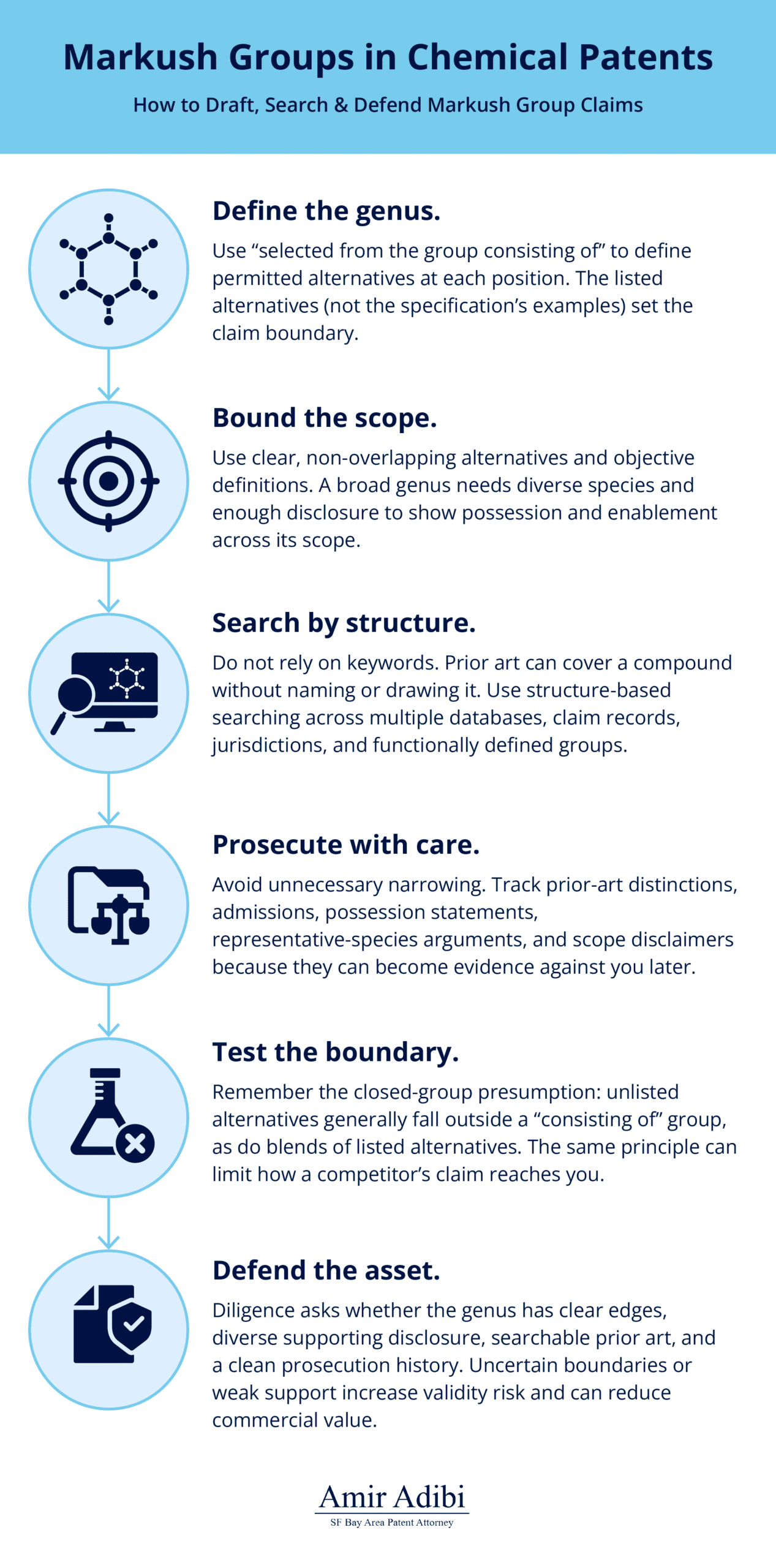
The Architecture of Markush Claims: Structure, Syntax, and Legal Foundations
Knowing where the boundary sits is not the same as knowing how it was built, and the construction details are what decide whether it holds. This section covers the vocabulary, the syntax and the hierarchy that every later decision depends on.
What a Markush Group Actually Is and Why Its Definition Determines Patent Scope
A medicinal chemist can draw one in thirty seconds. A hexagon, a nitrogen in the ring, two arrows pointing at positions labelled R¹ and R², and a list underneath of what each R is allowed to be. The drawing is not the invention. The list is.
That list is the legal instrument. A Markush group is a set of structurally related alternatives recited inside a single claim, and it works by asserting something specific: that within this invention, the listed alternatives are interchangeable. Substitute any permitted group at any permitted position, and you are still practicing the claim.
That assertion is the whole game. A plain list enumerates unrelated things, and nobody expects a common thread. A Markush recitation says the members belong together. An examiner will test that assertion during prosecution. A challenger will test it again a decade later, in a proceeding where your commercial position depends on the answer.
The construction is a century old. Eugene Markush’s examiner objected to his claim as alternative in form; the Commissioner approved it on petition and sent it back for examination on the merits, and the name attached itself to the format. The USPTO cites the decision as Ex parte Markush, 1925 Dec. Comm’r Pat. 126, 127 (1924). It was decided in 1924 and reported in the 1925 volume, which is why both years circulate.
Markush did not invent the format. He simply lost the argument that mattered, and then won it.
What makes the construction extraordinary is the arithmetic.
Worked Example: How four positions become thirty-six thousand compounds
| Position | Alternatives recited | Running species count |
| R¹ | 12 | 12 |
| R² | 20 | 240 |
| R³ | 15 | 3,600 |
| R⁴ | 10 | 36,000 |
Four variable positions. Roughly sixty words of claim language. Thirty-six thousand claimed compounds, of which the specification may exemplify a dozen and the laboratory may have made eight.
Markush Syntax: Drafting the Claim Language That Holds Up Under Scrutiny
“Selected from the group consisting of” reads like a formality, the sort of phrase a drafter reproduces without thinking. It is a scope rule with teeth, and it is the reason a claim reaches what it reaches.
In Multilayer Stretch Cling Film Holdings, Inc. v. Berry Plastics Corp., 831 F.3d 1350 (Fed. Cir. 2016), the Federal Circuit held that using “consisting of” to set off a claim element creates a very strong presumption that the element is closed, excluding anything not recited. Overcoming that presumption requires the specification and prosecution history to unmistakably manifest a different meaning. The court found nothing of the sort in the patent before it, and read the claim as limited to the four resins named.
The case carries a second holding that matters more in pharmaceutical practice, and it went the other way. Alongside the closed-to-unrecited-alternatives presumption sits a separate one, drawn from Abbott Laboratories v. Baxter Pharmaceutical Products, 334 F.3d 1274 (Fed. Cir. 2003), that a Markush recitation excludes blends and combinations of the alternatives it lists. That presumption the court found rebutted, because the intrinsic evidence showed that one recited resin was a broad term encompassing another recited resin. The definitions overlapped, so the list could not sensibly be read as offering four mutually exclusive choices.
Two presumptions, then, pointing in the same direction but holding with different strength. Closed to what you did not list is close to absolute. Closed to mixtures of what you did list is real but rebuttable — the court called that second presumption distinct from, and not as strong as, the first — and your own overlapping definitions are what rebut it. Judge Taranto dissented in part, reading “selected from” as modifying the group rather than the layer, so that “consisting of” did not by itself close the layer to unrecited ingredients.
Both presumptions cut in both directions. They constrain what your claim reaches. They equally constrain what a competitor’s claim reaches against you, which is why the analysis belongs in a freedom-to-operate workflow and not only in a drafting checklist.
Nesting is where syntax turns into a coherence problem. A claim may define R¹ as an alkyl chain substituted with a group that is itself selected from a subordinate list, and the subordinate list is a second Markush recitation sitting inside the first. Nothing prevents that subordinate list from admitting a substituent the parent definition excludes, or from duplicating one the parent already covers. Nobody drafts that deliberately. It arrives through amendment, when a position is narrowed in response to an office action and the nested definition below it is not conformed.
Six common drafting errors and what they cost:
| Drafting error | Why it fails | What the examiner or challenger does with it | Corrected construction |
| “Comprising” introduces the alternative group | Opens the group to unrecited alternatives, defeating the purpose of reciting a list | Challenger reads the claim onto art the drafter never meant to cover | “Selected from the group consisting of” |
| Overlapping alternative definitions in one list | Ambiguity as to which limb an accused compound satisfies, also rebuts the closed-to-blends presumption | Claim construction dispute, or an indefiniteness challenge on metes and bounds | Mutually exclusive definitions, or an express statement that overlap is intended |
| Alternative recited with no antecedent in the specification | Written description gap for that limb | Rejection during prosecution, invalidity as to the unsupported alternatives after grant | Every recited alternative anchored to a disclosed embodiment |
| Nested group whose members escape the parent definition | Internal incoherence, the claimed scope becomes indeterminate | Indefiniteness under the reasonable certainty standard | Subordinate group drafted as a true subset of the parent |
| Alternatives spanning unrelated structural classes | Members lack a shared structural feature | Improper Markush grouping rejection | Split into separate claims, or establish the shared structural feature and common use |
| Functional language at a variable position | The genus is defined by result rather than structure | Enablement and written description attack | Recite structure, reserve functional limitations for boundaries structure genuinely cannot express |
Genus Claims vs. Species Claims: Navigating the Hierarchy Within Markush Structures
One recitation does two jobs at once. Read as a whole it is a chemical genus claim, covering the entire family. Read at any single combination of permitted substituents it describes a species, and that species can be claimed separately, in a dependent claim or in its own application.
Most discussions treat the genus-versus-species question as a legal one, decided by counsel after the chemistry is settled. It is not. It is decided upstream, in medicinal chemistry and library design, by the people choosing which analogs to make. A genus claim is only as good as the disclosure supporting it, and the disclosure is whatever the program actually produced. If a compound library explored one region of chemical space intensively and left three others untouched, the claim architecture available months later has already been fixed, and no amount of drafting skill recovers what was never synthesized.
The commercial consequence runs through blocking patents and design-arounds. A genus broad enough to cover a competitor’s likely next compound is a blocking patent. A genus narrow enough that a single substitution steps outside it is a design-around invitation, and the substitution a competitor chooses will be the one your list forgot. Which of those you have built is a question about the list, not about the molecule.
When an accused compound sits outside the explicit alternatives but inside what looks like the structural logic of the claim, the closed-group presumption discussed above supplies most of the answer, and the answer is usually no. Courts describe an analytical framework here rather than producing predictable outcomes, and construction turns on the specification and prosecution history of the particular patent. Anyone who tells you how a given construction dispute will come out is guessing.
Claim at the genus level when:
- The structure-activity relationship is understood well enough to predict which substitutions retain activity.
- Backup series share the scaffold and would otherwise need separate filings.
- A trivial substitution would let a competitor step outside a narrower claim.
- The disclosure can support diversity across the full claimed scope.
File dependent species claims when:
- A lead compound has advanced far enough to carry commercial value on its own.
- The genus is broad enough that a validity challenge is foreseeable and fallback positions are needed.
- Clinical data will arrive after the filing date and cannot support the genus now.
- A specific species is the one a competitor is most likely to practice.
A boundary drawn this carefully is still only half the problem. It says nothing about whether somebody else drew one around the same space first, and finding that out is harder than most teams assume.
Structural Search and Prior Art: Finding What Standard Searches Miss
A well-drafted boundary is worthless if a competitor enclosed the same chemical space a decade earlier. This is the technical methodology section: search specialists should read it end to end, while readers who need the conclusion rather than the protocol can take the first and last parts and lose nothing they need.
Why Keyword and Text-Based Searches Fail on Markush Prior Art
A patent claim can cover a compound that appears nowhere in the patent’s text, so searching the text cannot tell you whether you are covered.
Everything in this section follows from that. A prior art claim with four variable positions covers tens of thousands of compounds it never names, never draws and never exemplifies. Your target molecule may be one of them. Run its name, its synonyms and its registry number through every full-text database in existence and the search returns nothing, correctly, because the compound genuinely is not in the text.
The legal mechanism that turns this from a theoretical worry into an invalidity risk is anticipation by a genus disclosure. In In re Petering, 301 F.2d 676 (C.C.P.A. 1962), the prior art disclosed a broad generic formula, but the stated substituent preferences narrowed it to a limited class of about twenty compounds, and the court held that a skilled artisan reading the reference would at once envisage each member of that class. Unnamed compounds inside the disclosure were treated as described.
The limits are as important as the rule. The court said explicitly that it was not the number of compounds that mattered, but the total circumstances: few variations at the variable position, only two alternatives at two others, no alternatives at the remaining ring positions, and a large unchanging structural nucleus. A broad generic formula, without more, does not anticipate everything inside it. How large a genus counts as large is judged as a skilled person in that particular technology would judge it, and the analysis is fact-dependent every time. The USPTO’s own treatment of the doctrine sits at MPEP § 2131.02, which adds a threshold the case reports make easy to miss: a skilled reader must be able to draw the formula or write the name of each compound before any of them can be at once envisaged.
For a searcher this converts into a triage rule. Prior art genera with few variable positions, tight substituent lists and stated preferences are high-risk and need genus-level review. Sprawling genera with dozens of open positions are lower-risk on anticipation, though they remain a coverage problem for freedom to operate, which is a different question answered in a different way.
Consider a composite of a pattern that recurs across the industry. A program clears its lead compound by name and by registry number, finds nothing, and advances. Somewhere in the art sits a claim from a different therapeutic area with a substituent defined as an optionally substituted alkyl rather than enumerated, and the lead compound satisfies it. The problem surfaces when a partner’s diligence team runs a structure search, which is typically after IND-enabling spend has been committed and before anyone wants to hear about it.
The same target compound, two search modes:
| A text search retrieves | A structure search retrieves |
| Patents naming the compound | Everything in the left column |
| Patents naming its synonyms and registry identifiers | Plus every claimed genus whose variable positions admit the compound as a member |
| Patents whose worked examples include it | Including genera that never name it, never draw it, and whose applicants never contemplated it |
The reverse direction of this problem, where prior art threatens your species claim rather than your genus claim, is treated in the litigation section below.
Substructure and Markush Structure Searching: What the Databases Can and Cannot Retrieve
Substructure searching asks a database to return every record containing a specified structural fragment, regardless of what else is attached to it. Exact-structure searching asks for one compound. The difference is the difference between asking who lives at this address and asking who lives on this street.
Both are necessary and neither is sufficient, because the prior art that matters most is often held in generic form. Chemical informatics platforms address this by decomposing claimed generic structures into searchable representations, an approach running from the early rule-based systems — the first operational database of this kind was indexed by hand — through to current work on automated interpretation. The major systems used for life sciences prior art searching, including SciFinder, Reaxys, Derwent Innovation and PatSnap, all provide some capability in this area. Their developers made independent decisions about how to do it, which is precisely where the risk lives.
Indexing gaps are what an experienced searcher worries about, and they fall into recognizable categories. Some content is indexed at claim level and some only at disclosure level, so a genus recited in the specification but not the claims may be retrievable in one system and invisible in another. Coverage varies by filing era, because older families were indexed under earlier conventions and were never fully reprocessed; the specialized indexing systems those records depend on were built largely between the 1960s and the 1980s and have not been substantially rebuilt since. Enumeration depth varies by source, since fully expanding a large generic structure is expensive and every provider drew the line somewhere. Jurisdictional coverage varies too, and a genus filed in a national office with thin structural indexing may not surface at all.
The conclusion is unglamorous and non-negotiable. No single database is complete on its own, and a search run in one system is a search, not a clearance. That is measurable rather than merely prudent: a quantitative study in World Patent Information showed that searching a Markush database returns patent families that specific-structure searching alone does not retrieve.
The hardest problem in this whole discipline is the functionally defined substituent. A prior art claim reciting “a C₁–C₆ alkyl optionally substituted with halogen” has not enumerated anything. It has described a rule for generating members, and the members are not in any index because they were never written down. Testing a target against that claim is an act of construction, not retrieval: read the limitation, determine the concrete set it admits, decide whether your compound’s substituent falls inside, and record the interpretation you applied and why. Two competent searchers can reach different answers on the same claim, which is the reason the record matters as much as the conclusion.
| Search mode | What it answers | What it misses | When it is required |
| Exact structure | Has this precise compound been disclosed or claimed? | Every genus covering the compound without naming it, salts and isomers indexed separately | Novelty screening, first-pass compound checks |
| Substructure | What has been disclosed containing this scaffold or fragment? | Genera whose positions are defined by class rather than enumeration, thinly indexed disclosure-level content | Prior art and landscape work, identifying families needing genus-level review |
| Markush genus | Does any claimed genus encompass this compound as a member? | Genera not enumerated to the required depth, coverage varying by era and source | Freedom to operate, and any clearance a client will rely on |
Identifying Hidden Structural Variants: The R-Group Problem in Prior Art Searches
Four categories of compound routinely sit inside a prior art genus while sitting outside a standard search result, and each is missed for its own reason.
- Tautomers. The same compound exists as interconverting forms, and a structure query built on one drawn form may not retrieve art drawn as the other.
- Stereoisomers. A prior art claim may leave stereochemistry unspecified, in which case the genus reads on configurations the reference never depicts and a stereospecific query never matches.
- Salts. A claim to a compound “or a pharmaceutically acceptable salt thereof” extends well past the drawn structure, and salt forms are frequently indexed as separate records from the parent.
- Prodrugs. A derivative that releases the parent in vivo may fall inside a genus drafted around the parent or outside it, and which one depends on how the genus was drafted rather than on the chemistry.
None of this is retrievable by judgment. It requires a procedure that runs the same way every time.
R-group enumeration protocol:
- Define the target completely: parent structure, stereochemistry, salt form, and any prodrug or active metabolite the program may pursue.
- Retrieve candidate genera by substructure, not by name, capturing every claim whose core structure the target could satisfy.
- For each candidate, tabulate the variable positions and the permitted alternatives at each, transcribed from the claim itself rather than from the abstract or the examples.
- Resolve every class-defined or functionally defined position into the concrete set it admits, and record the interpretation you applied.
- Test the target position by position against each genus, recording a hit, a miss, or an open question with the reason for it.
- Repeat steps 3 through 5 for the target’s tautomers, stereoisomers, salt forms and foreseeable prodrugs.
- Record the search date, the sources queried, the interpretations applied and the questions left open, and preserve it as a document.
Step 7 is the one that matters most later, for reasons the next part explains.
Freedom-to-Operate Analysis Using Markush Structural Mapping
Freedom-to-operate analysis for a chemical compound is structural mapping. The target is placed against every relevant genus in the landscape, one at a time, and the question asked of each is whether this molecule is a member.
Literal coverage is the first question and usually the decisive one. If the compound satisfies every limitation of a claim, including every variable position, it is covered, whatever the patent’s examples show. Coverage under the doctrine of equivalents is a second and genuinely unsettled question in chemical claims. Whether a substituent outside the recited alternatives is nonetheless insubstantially different is fact-dependent, constrained by prosecution history estoppel, and further constrained by the closed-group presumption discussed earlier. The honest posture is to identify it as an open question requiring specific analysis, not to state a rule.
Then the constructive half. Mapping the structural boundary of a competitor’s genus tells you exactly where their coverage stops, and the space immediately outside it is often patentable and unoccupied. A design-around is not a defeat. It is the output of the same analysis that identified the risk, and it frequently produces a better filing position than the original target, because the boundary was drawn deliberately rather than inherited.
Documentation carries its own weight. A contemporaneous record of methodology, sources and reasoning is what supports good-faith reliance if infringement is later alleged, and it is the reason step 7 of the enumeration protocol is not clerical. What that record establishes is that a competent analysis was performed on stated assumptions. It does not establish that the conclusion was right, and it should never be described internally as though it did.
FTO structural mapping workflow:
- Define the target and its foreseeable variants, per the enumeration protocol.
- Establish the landscape: therapeutic area, structural class, jurisdictions of commercial interest, and the in-force and pending families in each.
- Screen out genera the target cannot satisfy, recording why.
- For surviving genera, construe the claim, position by position, on the intrinsic evidence.
- Classify each as clear, covered, or open, and attach the reasoning to each classification.
- For covered and open results, map the structural boundary and identify candidate design-arounds.
- Document methodology, sources, dates, interpretations and residual uncertainty, and state plainly what the analysis does and does not establish.
Verifying coverage you cannot verify yourself:
Structural verification against every relevant genus in a therapeutic area is not work most R&D organizations are resourced to complete internally, and the gap usually surfaces at the worst possible moment. If you have a live compound and a clearance opinion built on text searching, reach out for a structural verification conversation before the next filing decision.
Drafting Strategy and Patent Prosecution: Building Markush Claims That Survive Examination
A searcher’s map of the landscape is the input to every drafting decision that follows, because breadth is only an asset if it survives examination. This section turns that map into filing decisions.
Crafting Markush Claims for Defensible Breadth Without Triggering Fatal Rejections
The constraint arrives before the drafting does. Claim architecture is limited by what the compound library actually contains, and the library was designed by medicinal chemists optimizing for activity, not for structural diversity across a future genus. A program that made forty close analogs of one lead has excellent data and a narrow disclosure. A program that made twenty compounds spread across four structural regions has thinner data and a genus that can be defended.
That trade-off is worth surfacing at library design, when it is still a choice. Six months later it is a fact.
Breadth against validity is a spectrum with named costs at each end rather than a call to be reasonable. A wide genus captures backup series and forecloses design-arounds, and it exposes every recited alternative to the disclosure requirements discussed below. A tight genus is comfortably supported and easily stepped around. Neither end is correct; what matters is knowing which one you chose and why.
The practical answer is not to pick a point but to build a ladder, so that a claim narrowed in prosecution or post-grant review lands on a rung rather than on the floor.
| Rung | Scope | Rationale |
| Broad genus | All four variable positions at full breadth | Maximum commercial reach and blocking value; carries the full § 112 exposure. |
| Intermediate subgenus | The position most vulnerable to attack narrowed to supported alternatives | Preserves most commercial scope while removing the weakest limb. |
| Narrow subgenus | Restricted to the structural regions actually exemplified | Aligned to the disclosure; the position most likely to survive a determined challenge. |
| Species | The lead compound and its immediate analogs | Independently valuable, independently defensible, and the fallback that keeps the asset alive. |
Responding to USPTO Markush Restriction Requirements and Unity of Invention Objections
The office action runs eleven pages, and somewhere on page three the examiner has written that the claim contains an improper Markush grouping, then asked you to elect a single species. Knowing which of those two things to argue, and where, decides how much scope survives.
The governing standard is framed as a rejection rather than a blessing, and the direction matters. Under MPEP § 2117, a claim contains an improper grouping if either the members do not share a single structural similarity or they do not share a common use. Where the alternatives are chemical compounds outside a recognized class, both limbs are treated as met when the alternatives share a substantial structural feature together with a common use that flows from that feature. The structural analysis compares compounds as wholes, following In re Harnisch, 631 F.2d 716 (C.C.P.A. 1980), rather than decomposing them into components and comparing the pieces.
Two procedural points are worth more than they appear. First, an improper Markush grouping rejection is a rejection on the merits and so is appealable to the Patent Trial and Appeal Board rather than petitionable, which is the opposite of ordinary restriction practice and a routine source of wasted months. Second, where the grouping is proper and an election has been required, the examiner must continue to search the species of the claim unless the claim has been found unpatentable over prior art. Nor may the examiner require an applicant to narrow a proper claim to a subset in the absence of a rejection.
Where the members are few enough or close enough that the whole claim can be searched without serious burden, there is correspondingly less basis for an election requirement, though a provisional election of species remains within the examiner’s discretion. That is leverage rather than a right, and the qualifier is doing real work: the duty attaches to proper groupings, so the first argument has to be won before the second is available. The Markush claim examination process is worth understanding in detail before responding, because the response is where scope is usually lost.
Precision about what is surrendered, and when, prevents the most common misunderstanding. Election of species restricts what is examined now. Abandonment of non-elected subject matter forfeits it from this application, though it can be pursued by divisional or continuation. Prosecution history estoppel constrains what you may later argue about the claims that did issue. Three separate consequences, three separate moments.
European practice is closer to American practice than most applicants expect, and diverges where it counts.
Restriction practice and unity of invention compared:
| Factor | USPTO | EPO |
| Governing provisions | 35 U.S.C. § 121, MPEP § 803.02 and MPEP § 2117 | Art. 82 and Rule 44 EPC, EPO Guidelines, F‑V, 3.2.5 and F‑IV, 3.7 (renumbered from F‑V, 2.2.2.2 — verify against the current edition) |
| Test applied | Improper grouping where members lack a single structural similarity or a common use | Alternatives of a similar nature: a common property or activity, plus either a shared significant structural element or membership in a recognized class |
| When it is raised | At restriction or election of species, usually before examination on the merits | At search and again in examination, may arise before or after the art is considered |
| Applicant’s obligation | Elect a species or grouping, may traverse | Pay additional search fees to keep non-unitary subject matter within the search |
| Consequence for genus scope | Non-elected subject matter pursued by divisional or continuation, election statements enter the prosecution history | Unsearched subject matter must go to a divisional, the search record constrains what can be prosecuted |
| Review route | Improper grouping rejection is appealable, restriction requirements are petitionable | Protest accompanied by the additional fee |
The substantive tests are near cousins. The divergence is in consequence and timing, which is where strategy actually lives.
Indefiniteness and Ambiguity: The Drafting Failures That Collapse Markush Claims
Breadth is not indefiniteness. A claim can be enormous and perfectly clear. What defeats a claim is uncertainty about where its edges are.
The standard comes from Nautilus, Inc. v. Biosig Instruments, Inc., 572 U.S. 898 (2014), which replaced the Federal Circuit’s older “insolubly ambiguous” formulation. A claim is invalid for indefiniteness if, read in light of the specification and the prosecution history, it fails to inform those skilled in the art about the scope of the invention with reasonable certainty. Applied to a chemical genus, the question becomes concrete: can a skilled chemist, holding the patent, determine which compounds are inside and which are outside?
There is also a route specific to this construction. A grouping may be so expansive that a skilled artisan cannot envision its members at all, in which case the metes and bounds of the claim cannot be determined and an indefiniteness rejection follows. That is a different failure from ambiguity in a single term, and it is the one large genera invite.
The most instructive decisions in this area are not about variable positions. They are about ambiguous terms in chemical claims, and two are worth knowing. In Teva Pharmaceuticals USA, Inc. v. Sandoz, Inc., 789 F.3d 1335 (Fed. Cir. 2015), on remand from the Supreme Court, the Federal Circuit held claims reciting a polymer’s “molecular weight” indefinite. Three different measures could be meant, the specification did not say which, and the prosecution history of related applications contained conflicting statements about the term. In Dow Chemical Co. v. Nova Chemicals Corp., 803 F.3d 620 (Fed. Cir. 2015), claims that had survived indefiniteness before Nautilus failed after it, when the method of measuring a claimed property turned out to be calculable several ways with none clearly identified.
The standard genuinely tightened, which Dow demonstrates by flipping on the same claims. It is not automatically fatal: the Supreme Court in Nautilus vacated and remanded rather than holding the claims before it indefinite, leaving application of the new standard to the court below.
Teva also supplies the most important lesson. The ambiguity was not simply drafted in. Examiners had twice rejected the term, and the patentee’s inconsistent responses across related applications became the evidence the court relied on. The claim was argued into indefiniteness. Every statement made in prosecution is a statement made to a future challenger.
Overlapping definitions are the failure mode most likely to arrive in your own file. Suppose a variable position permits “a halogenated alkyl” and, separately, “a chloromethyl group.” Every chloromethyl is a halogenated alkyl. A drafter reads that as harmless redundancy. A challenger reads it as evidence that the drafter did not know what the limbs meant, and uses it to argue both that the group’s boundaries are uncertain and that the recitation cannot have been intended as a set of exclusive choices.
Pre-filing ambiguity checklist:
- Can any single substituent satisfy two limbs of the same group simultaneously?
- Does every variable position have a stated outer boundary, with no gap between the enumerated alternatives and that boundary?
- Is every term of degree tied to a stated measurement method in the specification?
- Does every nested definition sit wholly inside its parent definition?
- Would a chemist outside the program reach the same membership answer as a chemist inside it, for a borderline compound?
- Is every recited alternative supported by a disclosed embodiment?
- Does anything said in prosecution to date contradict the construction you now rely on?
Written Description and Enablement Challenges Specific to Large Markush Genera
A genus claim asks for property across a range. The disclosure requirements ask what you have actually shown, and the gap between the two is where broad chemical claims are lost.
For written description, the en banc standard in Ariad Pharmaceuticals, Inc. v. Eli Lilly & Co., 598 F.3d 1336 (Fed. Cir. 2010), requires a claimed genus to disclose either a representative number of species falling within it, or structural features common to its members sufficient for a skilled artisan to visualize or recognize them. Representative means representative of the entire genus, so where variation within the genus is substantial the disclosure must reflect that variation. A structurally defined recitation has a real advantage on that second limb that a functionally defined genus does not, since the common structural feature is recited on the face of the claim. That advantage is worth understanding, because it is the strongest position available to anyone drafting in this format.
The first limb is where quantity misleads. In AbbVie Deutschland GmbH & Co., KG v. Janssen Biotech, Inc., 759 F.3d 1285 (Fed. Cir. 2014), the patentee disclosed roughly three hundred antibodies and still lost on written description, because the described species were all of a similar type — derived from a single parent and more than ninety per cent identical in the binding region — and did not qualitatively represent other regions of the claimed genus. The court’s image is the one to remember: analogizing the genus to a plot of land, disclosed species that abide only in one corner do not describe the plot. Merely drawing a fence around a perceived genus is not a description of it. What is required is diversity across the structural scope, not a large count in one region.
Then Amgen Inc. v. Sanofi, 598 U.S. 594 (2023), which is the most consequential recent development for anyone drafting broadly.
Amgen claimed an entire genus of antibodies defined by what they do, binding a specific protein and blocking it from binding another. The specification gave the amino acid sequences of twenty-six antibodies that worked, plus two methods for finding the rest: a roadmap for generating and screening candidates, and conservative substitution from a known working antibody. The Court, unanimously, held the claims not enabled. The two methods amounted to little more than two research assignments, and the governing principle was stated simply: the more one claims, the more one must enable.
The Court also refused to do what many commentators expected. Amgen argued the Federal Circuit had applied a heightened standard to genus claims; the Court agreed there is a single universal enablement standard and found the analysis below entirely consistent with it. There is no special rule for genus claims. There is one rule, applied to claims of different breadth, producing harder outcomes as breadth increases.
That is why the extension to structurally defined chemical claims is a matter of degree rather than a settled rule. Amgen’s genus was defined by function with the sequences unknown, so reaching its full scope required discovery. A Markush recitation names its members structurally, and a chemist who can read the claim can draw them. The difference is in claim architecture, not in the legal test, and how far the reasoning travels is still developing.
Two practical consequences follow. First, prophetic examples and working examples must be distinguishable on the page, conventionally by tense, and blurring them creates a problem entirely separate from enablement. Second, representative disclosure across the structural scope is what converts a broad genus from an aspiration into an asset. Where a genus spans several structural regions, pharmaceutical patent lawyer input at library-design stage costs less than the claims it saves.
Genus breadth against required disclosure:
| Genus breadth | What the specification must contain |
| Narrow subgenus, one structural region | Working examples across the recited alternatives, with activity data supporting the asserted common use |
| Moderate genus, related regions | Representative species from each region, plus structure-activity data establishing why the regions behave alike |
| Broad genus, multiple regions | Diverse representative species drawn from every region of variation, not concentrated where the chemistry was easiest, plus an explicit account of the common structural feature |
| Very broad genus approaching functional definition | At this breadth the disclosure burden approaches what Amgen found unmeetable, and a laddered set of narrower claims is usually worth more than one claim that does not survive |
Portfolio Strategy and Commercial Value: Building Around Markush Genera
A granted claim is the beginning of the asset’s life rather than the end of the drafting exercise, and its scope now starts producing commercial consequences. This section covers what that scope is worth and how it is arranged.
Pharmaceutical Patent Portfolio Architecture Built Around Markush Genera
Layered claiming is the standard answer to a simple problem: a single patent covering a single compound is a thin asset with a fixed expiry. Companies therefore build in tiers, with a genus patent covering the compound class and the analogs around it, species patents on the lead and the leading backups, and later filings on formulation, salt form, polymorph and method of use. Each tier protects something the others do not, and each has its own expiry.
Continuation practice is what lets that structure respond to data, and its mechanics are more constrained than the phrase “keeping a continuation open” suggests. A continuation claims different subject matter from the same disclosure, which means scope can be redirected within what was originally described, but nothing new can be added: § 132(a) bars new matter, and § 120 conditions the earlier filing date on the invention having been disclosed in the earlier application as § 112(a) requires. If a compound region was not disclosed at the priority date, no continuation reaches it. What continuations do allow is claiming, three years later, the region the clinical data made important, provided the original specification described it.
The commercial reading of all this happens in diligence, and it is more specific than most R&D leaders expect. A diligence team examines whether the recited alternatives are supported across their range, whether prosecution statements narrowed the effective scope below what the claim appears to say, whether the genus actually reads on the competitor products it was drafted to block, and whether a design-around sits one substitution away. A poorly bounded genus is not valued at zero. It is discounted, and the discount prices the validity risk the buyer is inheriting. That is the argument to make internally when patent spend is treated as cost rather than asset, and a structured patent portfolio analysis is what produces the evidence for it.
Layered protection and what each tier contributes:
| Tier | Covers | Contribution to the exclusivity timeline |
| Genus patent | The compound class and its analogs | Earliest filed, earliest to expire, blocks competitor entry into the structural space |
| Species patents | The lead compound and key backups | Survives if the genus is narrowed, anchors the commercial product. |
| Formulation and salt form | The delivered product | Filed later, expires later, protects the marketed form specifically. |
| Method of use | The indication | Extends into new indications as clinical data arrives |
Competitive Intelligence and Landscape Analysis Using Markush Structural Data
The same structural analysis that clears a compound also maps a field. Run across a therapeutic area rather than a single molecule, it groups claimed genera by scaffold and shows which structural regions are densely claimed, which are held by whom, and which are open. Mapping that last category is what white space analysis means in practice.
The technique is scaffold-based clustering of claimed genera, and its honest limitation should travel with it: the map is only as complete as the underlying indexing. Sparse regions may be genuinely open or merely poorly indexed, and distinguishing the two requires targeted searching rather than trust in the visualization.
Used properly, it also predicts. Patterns in a competitor’s filings, the regions they have claimed and the sequence in which they claimed them, indicate where their program is heading, often well before anything is disclosed clinically.
What a landscape analysis should surface:
- Which structural regions in this therapeutic area are claimed, by whom, and with what remaining term
- Which regions are open, and which of those are open because nobody has claimed them rather than because nobody has indexed them
- Where a competitor’s genus boundaries sit, and how close your program’s chemistry is to each
- Which competitor filings indicate a series still in preclinical development
- Which of your own claimed regions no longer correspond to anything the program is pursuing
Structural analysis is not a legal chore performed after the research is done. It is an input to research direction, and the programs that treat it that way spend their chemistry budget inside space they can actually own.
Markush Claims Under Attack: IPR, Post-Grant Review, and Litigation Exposure
A valuable genus is a targeted genus, and drafting and search decisions made years earlier determine what a challenger finds. That challenge now usually arrives as an inter partes review, the USPTO trial proceeding in which a third party attacks granted claims on novelty and obviousness grounds, and only on the basis of prior art consisting of patents and printed publications. This section covers what the attack looks like and what makes it fail.
How Challengers Attack a Markush Genus in Post-Grant Proceedings
The most economical attack on a broad genus claim is a single prior art compound. If one reference discloses a compound falling within the claimed genus, that reference anticipates the genus claim, and one well-chosen piece of art can invalidate a claim covering tens of thousands of compounds.
Precision matters here, because the proposition is routinely overstated. A prior art species anticipates the claim that encompasses it. It does not follow that every claim in the patent falls, or that the genus is invalid for all purposes. Narrower claims to unanticipated regions survive, and this is exactly what the claim ladder from the drafting section exists to provide.
Run the relationship the other way and the analysis changes completely. When prior art discloses a genus and the challenge is to your later species claim, the challenger must satisfy the narrower Petering conditions: a limited, well-delineated class that a skilled artisan would at once envisage on reading the reference. Broad generic disclosure without that constraint does not anticipate.
Holding both directions in view at once is the clearest way to think about this construction. Your genus is fragile against a single species in the art. Your species is comparatively robust against a sprawling genus in the art. The asymmetry is not intuitive, and it explains why portfolios built only at genus level fail in ways portfolios built as ladders do not.
Two directions, two standards:
| Factor | Prior art species against your genus claim | Prior art genus against your species claim |
| The legal question | Does the reference disclose a compound within the claimed genus? | Would a skilled artisan reading the reference at once envisage the claimed compound? |
| Governing standard | Ordinary anticipation | Petering and its progeny, a limited, well-delineated class |
| Difficulty for the challenger | Low: one reference, one compound | High: must show the disclosure is sufficiently constrained |
| What falls | The genus claim encompassing the species | The species claim, where the conditions are met |
In district court the fight is usually about construction rather than art. Whether an accused compound falls within the genus is answered largely by the closed-group presumption and by what the specification and prosecution history say about it. Courts apply a framework; they do not produce predictable results, and the outcome turns on the intrinsic record of the individual patent.
Defensive Strategies for Strengthening a Genus Against Challenge
Most of what determines the outcome of a post-grant challenge was decided before the patent issued, which is discouraging in retrospect and useful in prospect. The measures below are ordered by when they must be taken, because most of them cannot be taken late.
Prosecution history management deserves particular attention. Statements made to an examiner constrain how claims are construed years afterward, and Teva showed that inconsistent statements can supply the evidence that invalidates a term outright. Every response is drafted twice: once for the examiner reading it now, once for the challenger reading it later. Writing the second reader into the room changes what gets written.
Defensive measures and when each must be taken:
| Stage | Measure |
| Library design | Distribute synthesis across the structural regions the genus will claim. |
| Drafting | Build the claim ladder; anchor every recited alternative to a disclosed embodiment; eliminate overlapping definitions. |
| Filing | Include representative species from every region of variation; distinguish working from prophetic examples. |
| Prosecution | Traverse improper grouping rejections on the correct route; keep responses internally consistent across the family; say no more than the rejection requires. |
| Post-grant | Maintain continuations while data matures; monitor competitor filings against your boundaries. |
Where a challenge has already been filed, the record made during prosecution is largely the record you will defend on, and patent defense strategy is built around what that record already says rather than what anyone wishes it said.
The uncomfortable conclusion is also the encouraging one. Most post-grant vulnerability originates in decisions made during drafting and prosecution, which means most of it is preventable by people who are not in the courtroom and will never be.
Turning Markush Analysis Into a Repeatable Discipline
The boundary of a chemical patent is drawn twice. It is drawn once in the claim language, by whoever decided which alternatives to recite at which positions and how much disclosure would support them. It is drawn again, invisibly, by what a searcher is able to retrieve when someone finally asks whether a competitor enclosed the same space first.
Portfolios fail in the gap between those two lines. A genus that covers everything and is supported by nothing collapses under the disclosure requirements. A clearance built on text searching returns silence and is read as freedom. Neither failure announces itself at the time, and both surface at the moment of maximum commitment, when a partner’s diligence team asks a question nobody asked internally.
What closes the gap is procedure applied consistently, by people who understand that the drafting decision and the search decision are two views of the same object.
Markush Discipline: A Working Checklist
- Distribute compound library synthesis across the structural regions the genus will claim, before the chemistry is finished.
- Recite structure at every variable position, and reserve functional language for boundaries structure cannot express.
- Anchor every recited alternative to a disclosed embodiment, and confirm no two limbs of a group overlap.
- Build a claim ladder from broad genus to species, so that narrowing lands on a rung.
- Clear compounds by structure, never by name alone, and treat a completed search as a search rather than a clearance.
- Enumerate tautomers, stereoisomers, salt forms and foreseeable prodrugs against every candidate genus.
- Document search methodology, sources, interpretations and open questions, contemporaneously.
- Answer the pre-filing ambiguity checklist before filing, not after the first office action.
- Keep prosecution responses consistent across the family, and write every one for the challenger who will read it later.
- Re-check your own claimed regions annually against where the program has actually gone.
Several of those you can start this week without help. Library-scope decisions, the pre-filing ambiguity questions, documenting search methodology and reviewing whether your claimed regions still match your pipeline are all internal work, and doing them well changes outcomes.
Others are not internal work, and pretending otherwise is how the gap opens. Verifying structural coverage against every relevant genus in a therapeutic area, construing a competitor’s functionally defined substituent, and judging whether a specification supports the breadth of the claim it was written for all require capacity and judgment most R&D organizations do not hold in-house.
If there is a live compound and real doubt about whether the coverage analysis behind it was structural or textual, that doubt is worth resolving before the next filing decision rather than after. A structural verification or portfolio review conversation with a chemical patent lawyer starts with the specific compound and the specific question. Contact us today about your chemical patent.