
 August 5, 2026
 0 comments
The office action runs eleven pages. Your application covers a series of forty related compounds — one scaffold, varied substituents, one budgeted filing — and somewhere on page three the examiner has written that the claim contains an improper Markush grouping. A paragraph later, you are asked to elect a single species for examination. The filing budget you presented to your board last quarter no longer describes what is about to happen.
Markush claim examination turns on a single test, and you can run it yourself before any of this begins. A Markush claim covers a genus of alternatives in one claim, typically written as “selected from the group consisting of A, B, and C.” The USPTO accepts that grouping only when every member shares two things: a substantial structural feature, and a common utility that flows from that shared feature. Satisfy both prongs on the record and the claim generally holds together. Fail either one and the examiner issues an improper Markush grouping rejection, frequently alongside an election-of-species requirement that pushes the alternatives you did not elect out of the application and toward separate divisional filings.
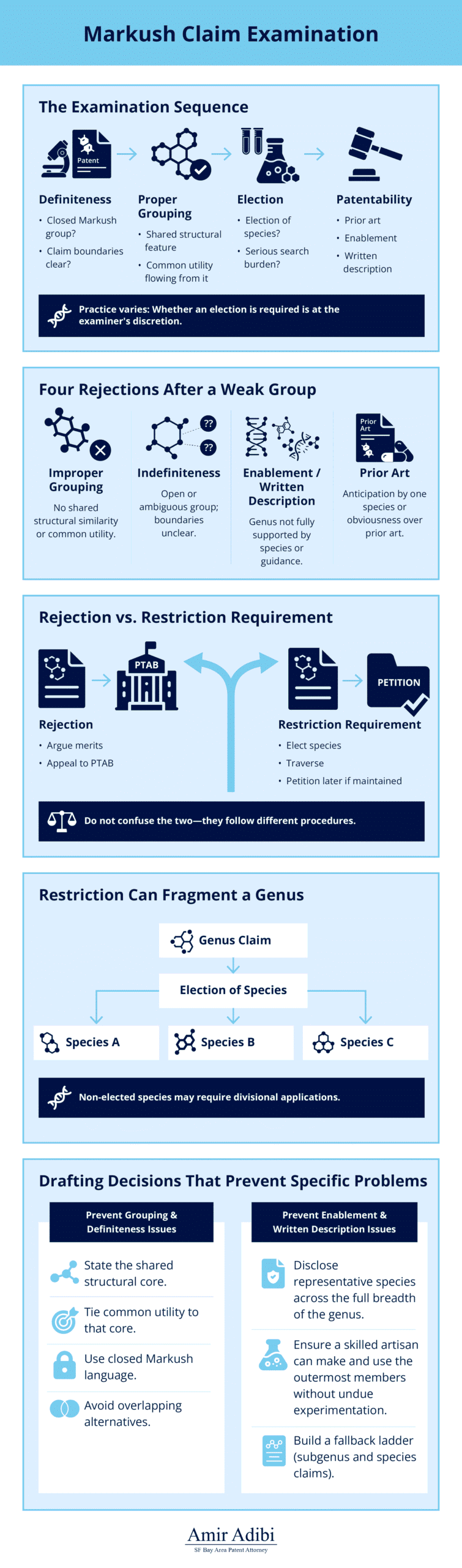
Those two outcomes are not handled the same way. A rejection is argued and appealed to the Patent Trial and Appeal Board; a restriction requirement is traversed and petitioned. Confusing them is one of the most expensive mistakes in this area of practice. What follows is the examination sequence in the order examiners actually apply it, the four rejections that follow a weak group, the restriction machinery that fragments a genus, and the drafting decisions that prevent all of it.
Key Takeaways
- Markush claim examination order: definiteness, proper grouping, election, patentability. Whether an election is required at all is discretionary, which is why practice varies by art unit.
- Four rejections follow a weak group: improper grouping, indefiniteness, enablement and written description, prior art.
- The fork decides where you fight. A rejection is appealed to the PTAB (35 U.S.C. §134; 37 CFR §41.31(a)(1)); a requirement is traversed, then petitioned under 37 CFR §1.144.
- Distinctness alone does not justify restriction. For a proper group searchable without serious burden, the examiner must examine every member.
- Rejoinder is narrow — only claims requiring all the limitations of an allowable claim, which mutually exclusive species do not. Divisionals are the primary route back.
Understanding the Legal Foundation of Markush Claim Examination
Defining a Markush Claim, and Why Its Architecture Decides the Outcome
A Markush claim is a genus claim built from a closed list of alternatives, and the architecture of that list determines almost everything that happens next.
The construction exists because examiners once resisted claiming a group of related compounds in the alternative. The applicant in Ex parte Markush did it anyway, the practice stuck, and the name attached itself to the format. The USPTO cites the decision as 1925 Dec. Comm’r Pat. 126, 127 (1924) — decided 1924, reported in the 1925 volume, which is why both years circulate. That is the entire history you need.
What matters now is the word consisting. A Markush group is closed: the selection is made from a group “consisting of” the listed members rather than “comprising” them. Write the group as open — “comprising,” or “consisting essentially of” — and the claim invites a rejection for indefiniteness, because nobody can tell what else you meant to cover.
Closure operates on two separate questions, and practitioners routinely collapse them:
- Closed to unlisted members. A very strong presumption, and the MPEP’s authority is Amgen Inc. v. Amneal Pharmaceuticals LLC, 945 F.3d 1368 (Fed. Cir. 2020): a claim element set off with “consisting of” is presumed closed to unrecited elements. The listed members must also be substitutable, one for the other, with the expectation of the same intended result — Multilayer Stretch Cling Film Holdings, Inc. v. Berry Plastics Corp., 831 F.3d 1350 (Fed. Cir. 2016).
- Closed to mixtures of listed members. Closure is the starting point here too, on the authority of Abbott Laboratories v. Baxter Pharmaceutical Products, Inc., 334 F.3d 1274 (Fed. Cir. 2003). Whether a given specification overcomes it is a construction question decided on that patent’s own record, not something to plan around.
The practical instruction is unglamorous, and the MPEP states it directly: if the claim is meant to cover combinations, say so, with qualifying language such as “at least one member selected from the group” or “or mixtures thereof.”
Closure carries a second consequence downstream. A dependent claim reaching outside its parent’s closed group does not narrow that claim — it contradicts it, which is a §112(d) problem rather than a drafting preference. A biotech patent law attorney can audit a claim set for that defect in an afternoon.
What the MPEP Actually Says, and the Order Examiners Work In
Examiners are not improvising. They are working a published sequence, and you can hold your office action against it line by line.
Four sections of the Manual of Patent Examining Procedure carry the weight here.
MPEP 2117 governs Markush claims, supplies the guidelines for determining whether a grouping is proper, and provides the basis for rejection where it is not. MPEP 2173.05(h) treats alternative limitations under 35 U.S.C. §112(b), including the closed-group requirement. MPEP 803.02 governs election of species requirements in Markush claims. MPEP 818 and its subsections govern election and traverse.
One note on citations you may meet elsewhere: the improper grouping rejection previously sat at MPEP 706.03(y) and now lives at 2117, where both 803.02 and 2173.05(h) cross-refer for the analysis. If a memo cites 706.03(y), it predates the move.
The USPTO patent examination sequence runs in this order:
- Definiteness. Is the claim clear, and is the group properly closed?
- Proper grouping. Do the members share a single structural similarity and a common use?
- Election. Should a provisional election of species be required, and is there a serious search and examination burden?
- Patentability. Does the elected species survive the prior art, and does the specification support the full genus?
Practice does vary across art units, and the reason is structural rather than arbitrary: MPEP 803.02 provides that where a claim containing a Markush grouping reads on two or more patentably distinct inventions, a provisional election of species requirement may be made at the examiner’s discretion. Discretion produces variation. Anyone who tells you the outcome is fully predictable across Technology Center 1600 is overstating it.
Reading the Genus-Species Relationship the Way an Examiner Does
Your claim describes a genus; your specification describes species. The examiner reads them together, and a mismatch produces two problems at once.
The two-prong test is the spine of everything that follows. A claim contains an improper Markush grouping if the members either fail to share a single structural similarity or fail to share a common use. Form paragraph 8.40 — the text an examiner pastes into the office action — gives two routes to propriety: membership in the same recognized physical, chemical, or art-recognized class with a common use; or, for chemical compounds outside such a class, a substantial structural feature plus a common use that flows from that feature.
The phrase “flows from” is doing real work. It is not enough that each compound in your group happens to be useful. Twenty compounds that each treat a different indication share no common utility in the relevant sense, even if all twenty are genuinely useful. The utility has to trace back to the structure you say they share.
And the mismatch does not arrive as one problem you can address at leisure. MPEP 803.02 states plainly that both a provisional election of species requirement and an improper Markush grouping rejection may apply to the same claim, and directs examiners who see an apparently improper grouping to require an election. One sequencing detail tells you what to expect: a written election requirement issued separately from the first action on the merits should not carry the grouping rejection. A weak genus-species hierarchy is not a risk that might surface. It is two documents in the same envelope.
Once the foundation is clear, the rejections stop looking arbitrary and start looking like a checklist being worked in order.
The Core Rejection Framework: Grouping, Definiteness, Enablement, and Prior Art
Improper Markush Grouping and the Structural Similarity Requirement
This is the rejection unique to Markush practice, and it turns entirely on the two prongs.
Consider two groups, described structurally rather than by name.
Likely proper: a single heterocyclic core, unchanged across every member, with variation confined to substituents at two positions. The shared core is recited in the claim and described in the specification as the feature responsible for the compounds’ activity. Every member is useful for the same purpose, and that usefulness traces to the core.
Likely improper: four unrelated chemical classes — a peptide, a small-molecule kinase inhibitor, an oligonucleotide, and a natural product extract — grouped because all four showed activity against the same target. Shared indication, no shared structure. The tie between them is the disease, not the chemistry. The MPEP works a published example on this exact pattern — a herbicide list spanning inorganic salts, acids, amides, nitriles, phenols, amines, and a heterocycle, all plainly herbicides, and still improper for want of a shared structural feature.
Note what distinguishes them. It is not size. A group with two hundred members sharing one scaffold is easier to defend than a group of four spanning unrelated classes.
Breadth does not cause this rejection. Unstructured breadth does.
You have two routes out, and they are not equivalent:
- Divide the claim. Set out each alternative, or grouping of patentably indistinct alternatives, in a series of independent or dependent claims. This resolves the rejection and costs you the single-claim structure you wanted.
- Argue the prongs. Present convincing arguments that the members do share a single structural similarity and a common use. Harder, slower, and the only route that preserves what you filed for.
Both are the routes form paragraph 8.40 itself offers, and the rejection is maintained until one lands or the examiner withdraws it. No Markush claim can be allowed while it stands.
One point deserves emphasis because secondary sources routinely blur it: this is issued as a rejection, not as a restriction requirement. That distinction determines where you go to fight it.
Definiteness Rejections Under §112(b)
Most indefiniteness rejections against Markush claims come from four recurring drafting habits, most of them avoidable.
The standard, as the MPEP applies it here, asks whether a skilled artisan can determine the claim’s metes and bounds — whether a boundary can be drawn between what it covers and what it does not. Where a group is so expansive that its members cannot be envisioned, §112(b) is in play. Failures cluster:
- Open-group language. Writing “comprising” or “consisting essentially of” where you meant a closed group. Drafters reach for this believing it buys breadth. It buys a rejection.
- Overlapping alternatives. Substituent definitions written so that a single species can be reached through two different branches of the formula. The claim then covers the same compound twice by two routes, and its boundary becomes unclear.
- Undefined structures. Terms like “alkyl” or “substituted aryl” carried into the claim without the bounds the specification assumes.
- Ambiguous alternation. “Or” constructions inside a group where the reader cannot tell whether members combine.
A Markush group may contain a very large number of alternatives without being indefinite for that reason alone. Size is not the defect. Ambiguity is.
Fixing indefiniteness usually means amending, and amendments are permanent in a way that arguments are not. Every word you add to resolve this rejection is on the record for the life of the patent, which is why the choice between arguing and amending gets its own treatment.
Enablement and Written Description Across a Genus
Your claim can be perfectly definite and properly grouped and still fail, because the specification does not carry the breadth the claim asserts.
These are two requirements, not one, and conflating them means fixing the wrong problem:
- Enablement asks whether a skilled artisan could make and use the full genus without undue experimentation. The In re Wands factors frame that inquiry — they are enumerated at MPEP 2164.01(a), and four carry most of the weight in chemical practice: the predictability of the art, the guidance and working examples, the breadth claimed, and how much experimentation is left to the reader.
- Written description asks whether you actually possessed the genus when you filed; the governing guidance sits at MPEP 2163. A specification can teach someone how to make compounds it never shows you conceived.
What satisfies written description is more concrete than most drafters assume: representative species disclosed across the full breadth, or a common structural feature the specification actually describes. Three examples clustered at one end of a wide genus satisfy neither.
In the case of Amgen Inc. v. Sanofi, 598 U.S. 594 (2023), the Supreme Court invalidated antibody claims defined by function — by what the antibodies bound and blocked, not by their structure. A structurally defined genus is a different animal, and the distinction is not cosmetic.
It is also an opportunity. A specification need not describe how to make and use every embodiment: an example or a few may suffice where it also discloses, in the words Amgen quotes from The Incandescent Lamp Patent, 159 U.S. 465, 475 (1895), “some general quality . . . running through” the class that gives it “a peculiar fitness for the particular purpose.” A well-drafted Markush claim — shared core, common utility flowing from it, both stated in the specification rather than implied — is that showing, made structurally.
The drafting discipline recommended here is not merely examination hygiene. It is the post-Amgen argument for breadth. Portfolios spanning devices, diagnostics, and therapeutics raise this across claim types, which is territory for a biomedical patent law attorney.
| Requirement | What the examiner is asking | What fixes it |
| Enablement | Could a skilled artisan make and use the outermost members without undue experimentation? | Working examples spanning the breadth; synthetic guidance for the hard cases. |
| Written description | Did you possess this genus at filing? | Representative species across the breadth, or a described common structural feature. |
| Definiteness | Can a skilled artisan tell what is in and what is out? | Closed group language; non-overlapping substituent definitions. |
Anticipation and Obviousness Against a Genus
A single prior art compound does very different damage depending on which rejection the examiner reaches for.
Anticipation is the narrower problem, and unforgiving in a specific way: where a claim reads on multiple species, only one need be taught by the prior art for the claim to fall. The standard repair is a disclaimer — a proviso carving the offending species out, which is a negative limitation governed by MPEP 2173.05(i). The claim survives, slightly smaller — though where the group is drawn from a recognized class of equivalents, the group itself tends to prove its members equivalent, and one anticipated member can carry the rest.
Obviousness is harder to survive intact. It usually arrives through close structural similarity to a prior art compound — the territory of MPEP 2144.09 — and turns on whether a skilled artisan would have selected that compound as a starting point and been motivated to modify it as you claim with a reasonable expectation of success.
The difference matters strategically. Anticipation attacks a point; you excise the point. Obviousness attacks the neighborhood around a point, and you cannot excise a neighborhood without giving up the structural space that made the genus worth claiming. Small-molecule programs facing this pattern often benefit from involving a pharmaceutical patent law attorney before the first substantive response.
If you are holding an office action and cannot tell which of these four categories it falls into, that diagnosis is worth an hour of specialist review before you draft a response.
Knowing which rejections are coming is only half the problem. The other half arrives when the examiner decides your single claim was never one invention.
Restriction Requirements, Elections, and Where Portfolios Fragment
How a Restriction Requirement Multiplies Your Filing Costs
A restriction requirement does not reject your claim. It decides your claim was never one invention, and that distinction is what makes it expensive.
Improper Markush Grouping Rejection vs. Restriction Requirement:
| Issue | Improper Markush grouping rejection | Restriction / election of species requirement |
| What triggers it | Members lack a single structural similarity or a common use (MPEP 2117). | Claim covers independent and distinct inventions and a serious search and examination burden exists (MPEP 803, 803.02). |
| What it asserts | The claim as written is not a proper grouping. | The claim was never a single invention. |
| What it demands | Amend into separate claims, or argue both prongs are met. | Elect one species or group for examination. |
| How you challenge it | Argue on the merits, then appeal. | Traverse with specific reasons, then petition. |
| Where the challenge goes | PTAB, under 35 U.S.C. §134 and 37 CFR §41.31(a)(1). | Petition to the Director under 37 CFR §1.144, after a final requirement. |
| Cost if it stands | Claim set fragments within one application. | Non-elected subject matter leaves the application; recovery means divisional filings. |
The cost of the right-hand column compounds in a way the left-hand column does not. Each divisional carries its own filing, search, and examination fees, its own prosecution track and attorney time, its own responses, its own issue fee, and its own maintenance fees across the life of the patent. Current amounts are published in the USPTO fee schedule.
Three things applicants routinely do not know:
- Distinctness alone is not enough. Where the members of a proper Markush group are sufficiently few, or so closely related, that the entire claim can be searched without serious burden, MPEP 803.02 says the examiner must examine all of them on the merits — even if directed to independent and distinct inventions — and will not require an election. Note the qualifier: the duty attaches to proper groups, so the argument is yours only if the first prong is met. Naming the standard accurately turns a traverse from a complaint into an argument.
- A safe harbor exists, with statutory conditions. Under 35 U.S.C. §121, a patent issuing on an application in which a restriction was made, or on one filed as a result, cannot be used as a reference against the divisional, the original, or any patent issued on either — provided the divisional is filed before the other patent issues. That timing condition is statutory text, not practitioner gloss. The prohibition reaches divisionals with consonance only; continuations and CIPs are outside it.
- Rejoinder is real, but narrower than it sounds. Under MPEP 821.04 the propriety of the restriction is reconsidered once all claims to the elected invention are allowable. The eligibility gate is the part usually left out: a non-elected claim must depend from or otherwise require all the limitations of an allowable claim, and one that does not is not rejoined. For a compound family that means rejoinder runs through an allowable generic, linking, or subcombination claim, not from one species to another — and non-elected claims should be amended during prosecution to require the elected invention’s limitations, or the right may be forfeited.
Making a Provisional Election Without Surrendering Scope
The election response feels like paperwork. It is a substantive filing, and it is where scope disappears quietly.
A provisional election is your designation of which species or group will be examined now. Three mechanics govern it, and together they produce one instruction:
- You must elect even if you disagree. Under 37 CFR §1.143, an applicant requesting reconsideration must indicate a provisional election of one invention for prosecution, which becomes the elected invention if the requirement is made final. Refusing to elect preserves nothing.
- You must traverse to preserve your right to petition. MPEP 818.01(c) is explicit: every error relied on in the petition must be distinctly and specifically identified in a timely traverse. The rule carries the same condition — a §1.144 petition will not be considered where reconsideration was never requested.
- Your traversal must give specific reasons under 37 CFR §1.111. A merely broad allegation of error does not satisfy the rule, and the election then becomes one without traverse.
So elect, and traverse with specific reasons, in the same response.
What the response should avoid is subtler. The temptation is to argue the merits of your grouping — to explain at length why these compounds really do share a core. Every such sentence is a characterization of your own invention, made under time pressure, and it will still be on the record when a competitor’s litigator reads the file a decade from now. Traverse the burden. Argue the grouping when the grouping is actually the question in front of you.
Do: state that election is made under protest; identify the elected species precisely; give specific reasons the search burden is not serious; reserve your rights as to non-elected subject matter.
Do not: concede that the members are patentably distinct; explain your structural similarity theory in detail; characterize the scope of the shared core; treat silence as neutral.
Species Requirements and the Compounds You Did Not Elect
Electing one species does not necessarily forfeit the rest. What you say while electing can.
Three distinct things happen when a species requirement lands, and running them together is what makes the requirement feel worse than it is.
First, examination narrows to what you elected. Second, the arguments you make about the elected species can create prosecution history estoppel that reaches the whole genus, because you are characterizing the genus every time you explain why the species is patentable over the art. Third — and this is the question that actually matters — the scope you can eventually enforce depends on what survives to issuance, not on what you elected.
That third point deserves a direct answer, and the MPEP gives a better one than reassurance would. Election does not license the examiner to shrink a good claim: where the grouping is proper, the examiner must keep searching its species unless the claim is found unpatentable, and may not require you to limit it to a subset absent a rejection. Where the full scope has been searched and found allowable, the requirement is withdrawn. Election governs the sequence of examination, not the claim.
What erodes enforceable scope is the record: the amendments, the disclaimers, the explanations of what your invention is not. Rejoinder under MPEP 821.04 is genuine but narrow — it reaches only claims requiring all the limitations of an allowable claim, which for mutually exclusive species means an allowable generic or linking claim rather than species-to-species recovery. One more reason the election response should read as procedural rather than substantive.
Election deadlines run fast, and the response is difficult to undo. A strategy review before the deadline costs much less than a divisional afterward.
Unity of Invention Across the USPTO, PCT, and EPO
The same Markush group can hold together in one office and split in another — but the tests are closer than most applicants fear, and the consequences are further apart.
PCT practice. Unity turns on special technical features, defined in PCT Rule 13.2 as those defining a contribution each claimed invention makes over the prior art. Paragraph 10.17 of Chapter 10 of the PCT International Search and Preliminary Examination Guidelines applies Rule 13.2 to Markush practice, treating the requirement as met where the alternatives are of a similar nature — for chemical compounds, a common property or activity plus either a shared significant structural element or membership in a recognized class.
EPO practice. Article 82 EPC and Rule 44 EPC establish the requirement, and the EPO Guidelines apply materially the same criteria. One caution: the EPO revises the Guidelines annually and renumbers Part F as it does, so check any section number against the current edition on epo.org before relying on it.
USPTO practice. Independent-and-distinct plus serious search burden, as set out above.
The divergence is the part worth knowing. Because the PCT and EPO tests depend on the shared feature contributing over the prior art, unity can fail after the search. Chapter 10 draws the distinction directly: lack of unity may be evident a priori, before any prior art is considered, or emerge only a posteriori, once a feature shown to be known or obvious no longer defines a contribution over the art. A group unitary on filing can stop being unitary the moment a reference lands. US practice has no equivalent mechanism.
How Three Offices Evaluate a Markush Group:
| Offices | USPTO | PCT (ISA/IPEA) | EPO |
| Governing test | Independent and distinct, plus serious search burden | Same or corresponding special technical features (Rule 13.2) | Single general inventive concept (Art. 82 EPC) |
| What must be shared | Substantial structural feature and common utility flowing from it | Common property or activity, plus shared structural element or recognized class | Common property or activity, plus shared structural element or recognized class |
| When it can fail | On the face of the claims | Before or after the search — a priori or a posteriori | Before or after the search, once prior art is considered |
| What it costs | Divisional filings | Additional search or examination fees | Additional search fees, then divisional filings |
Two coordination moves follow. First, sequence amendments so that a narrowing made to satisfy one office does not become an unnecessary admission in another. Second, align the shared structural feature you identify across every family member, so three offices are reading the same story about what your invention is.
Every problem described so far has a response. The responses that work best are designed into the application before the first office action issues.
Advanced Prosecution Strategies and Claim Drafting Practices
Drafting Claims That Preempt the Rejections
Almost every rejection in this guide traces to a drafting decision, which means almost every one of them can be engineered out.
Seven principles, each naming what it prevents:
- State the shared structural core in one sentence — in the claim and in the specification. Prevents improper grouping.
- State the common utility and tie it explicitly to that core. Prevents failure of the second prong.
- Close the group deliberately, and say whether combinations are included. Prevents indefiniteness and construction surprise.
- Verify no dependent claim reaches outside the closed group. Prevents a dependent claim that contradicts rather than narrows its parent, and the §112(d) problem that follows.
- Define substituents so no species is reachable through two branches. Prevents indefiniteness.
- Disclose representative species across the full breadth. Prevents written description failure.
- Build the fallback ladder. Limits the cost of losing the top claim.
The fallback ladder deserves plain explanation. You claim the broad genus at the top, progressively narrower subgenera beneath it, and specific species at the base. If the examiner takes the top claim, you have not lost the filing — you have lost one rung. Applications drafted with a single broad claim and nothing beneath it convert every adverse ruling into a crisis.
Principle one arguably carries more weight than the other six combined, and the reason is where you state the core. A shared core recited only in the claim leaves your attorney arguing from inference. A shared core described in the specification — named, explained, and tied to the activity — means the record supports your grouping argument from the day you file, before anyone has objected to anything.
Choosing Between Arguing and Amending
The choice is really a choice about what you are willing to give up permanently.
Arguments can be revisited. Amendments cannot. Work through four questions before you decide:
- Does the cited art actually fall within the genus as claimed, or has the examiner read the formula more broadly than it reads?
- Is the concession reversible? An argument you lose can be remade differently. Claim language you surrender is gone.
- Does the amendment give up commercially relevant space — the analogs your chemistry team is actually pursuing?
- Is the examiner’s position vulnerable on the record as it currently stands, or would you be arguing into a well-supported rejection?
Before committing to any of it, consider an examiner interview. An interview lets you test how the examiner is reasoning about structural similarity without filing anything, and a position that collapses in a twenty-minute conversation is a position you did not want to put in writing.
The prosecution history estoppel thread running through this article closes here. Indefiniteness amendments, prior art provisos, and election responses are three doors into the same room: each one puts a permanent statement on the record about what your invention is not.
Appeals Versus Petitions
Picking the wrong forum wastes months, and the choice is dictated entirely by which type of action the examiner issued. A rejection goes one way; a requirement goes the other.
- Appealing a rejection. MPEP 2117 says it in terms: an improper Markush grouping rejection is a rejection on the merits, appealable to the PTAB under 35 U.S.C. §134 and 37 CFR §41.31(a)(1). Form paragraph 8.40 exists partly to tell you so — it advises that the rejection is appealable rather than petitionable.
- Petitioning a requirement. Review comes by petition under 37 CFR §1.144 after a final requirement, no later than appeal, and only if you traversed properly. The authority behind this side of the fork is In re Hengehold, 440 F.2d 1395 (CCPA 1971), which the MPEP cites for the proposition.
That second condition is where cases are lost before anyone reaches a forum. The petition right is preserved by the traverse, or it is gone.
The Board has reversed improper grouping rejections where an examiner treated structural differences as dispositive without weighing the compounds as wholes, and the USPTO publishes one such decision itself. In Ex parte Dams, at MPEP 2117 subsection IV.B, the Board held the examiner erred by focusing on the individual Markush moiety rather than the compounds as a whole, which shared a structural feature essential to the claimed utility. The principle runs back to In re Harnisch, 631 F.2d 716 (CCPA 1980), and In re Jones, 162 F.2d 479 (CCPA 1947).
The record supporting an appeal is not built at appeal. It is built across prosecution, through arguments preserved, evidence submitted, and concessions avoided, which is why the election response matters far more than its length suggests. Patent defense work depends on a record made years earlier.
Managing a Markush Claim Across a Patent Family
A restriction requirement is not necessarily lost coverage. It is redirected coverage, if the family is managed deliberately.
Start with the founder’s question, because it has a clean answer. Did I lose the compounds I did not elect? Usually not. You can pursue them in divisionals, and §121 protects those divisionals from double patenting attacks by the parent if you meet its conditions. What you lose is budget certainty, not subject matter.
Three traps sit in the strategies that follow:
- Rejoinder can cost you the safe harbor. It works by withdrawing the restriction requirement, and once that is withdrawn §121 no longer applies. A claim pending in a divisional may then draw a double patenting rejection it was previously shielded from — good news in the application in front of you, a question to model across the family.
- Continuation-in-part limits. When new analogs emerge after filing, a CIP is the obvious vehicle, and the §121 safe harbor does not extend to it: a patentably indistinct claim in a continuation or CIP, or in a divisional without consonance, is exposed to double patenting over the parent. New matter is also entitled only to the later filing date for that matter.
- Overlapping genera across the family. Family members claiming overlapping Markush groups can draw obviousness-type double patenting rejections, and terminal disclaimers carry consequences for term and for enforceability that should be modeled before a disclaimer is filed. This area has moved recently; treat any general guidance as a starting point rather than an answer.
Coordinated properly, a family creates overlapping layers rather than duplicate coverage: the broad genus in one member, commercially critical subgenera in another, key species in a third. Mapping that across an existing family is what patent portfolio analysis is for, and it is considerably easier to do before a restriction requirement than after one.
All of it is only useful if applied before the application is filed, which is exactly what the following checklist is for.
Your Pre-Filing Markush Audit Checklist
Everything below is answerable in an afternoon, by you and your counsel, using documents you already have. Ten questions; answer each yes or no.
- Have we identified, in one sentence, the structural feature every member of the group shares?
- Does the specification state that shared feature expressly, not just imply it?
- Does every member share a common utility that flows from that shared feature?
- Are representative species disclosed across the full breadth of the genus, not clustered at one end?
- Can a skilled artisan make and use the outermost members without undue experimentation?
- Do any substituent definitions overlap, so that one species is reachable through two branches of the formula?
- Does the claim set include a fallback ladder of subgenus and species claims?
- Is the group closed in the way we intend, including as to combinations?
- Have we searched for prior art species falling inside the genus?
- Does the claim scope match where the commercial product is actually heading?
Every “no” is a rejection someone will write later, at a price. A “no” on question two is an improper grouping rejection. A “no” on question four is a written description rejection. A “no” on question six is an indefiniteness rejection.
None of them are hard to fix the week before filing; all of them are expensive to fix after an examiner has committed a position to paper.
Protecting a Compound Family Without Fragmenting Your Portfolio
For biotech innovators, Markush claim examination reduces to one question asked twice: do the members of your group share a substantial structural feature, and does their common utility flow from it? Everything else in this guide is a consequence of the answer.
Scope is lost at three moments in particular. It is lost at drafting, when the shared core is left implicit. It is lost in the election response, when a filing that felt like housekeeping becomes a concession. And it is lost in the choice between arguing and amending, when a permanent change is made to solve a temporary problem.
The pattern worth taking away is that fragmentation is almost never something that happens to you. It is the delayed result of a decision made months earlier, which is the same reason it is preventable. That is not a comforting thought so much as a useful one.
This week, you can do three things. Run the checklist above against your most important pending claim set. Ask your counsel which prong of the two-prong test your specification supports and where in the specification it says so. And if an office action is already on your desk, identify where it belongs in improper markush grouping rejection vs. restriction requirement before you draft a word of response.
None of it requires new science — only writing down, early, the thing you already know about your compounds: what they share, and why that shared thing is what makes them work. An examiner, a foreign associate, and a competitor’s litigator will each read that answer years apart. The only choice is whether you wrote it, or left them to infer it.
This article is general information about US patent examination practice and is not legal advice. Outcomes depend on the specific facts of an application, and no result is guaranteed. Consult a registered patent attorney for a pre-filing Markush audit or an office action response strategy.