
 July 8, 2026
 0 comments
A USPTO terminal disclaimer accepted three years ago does not feel like a live risk. It sits in the file wrapper, a single recorded page, long since forgotten. Then an accused infringer’s counsel pulls it during discovery, notices that the assignee who signed it had not yet recorded its assignment — and a patent your client has been enforcing becomes a liability. That is the defining feature of these filings: the damage is quiet, delayed, and almost never reversible.
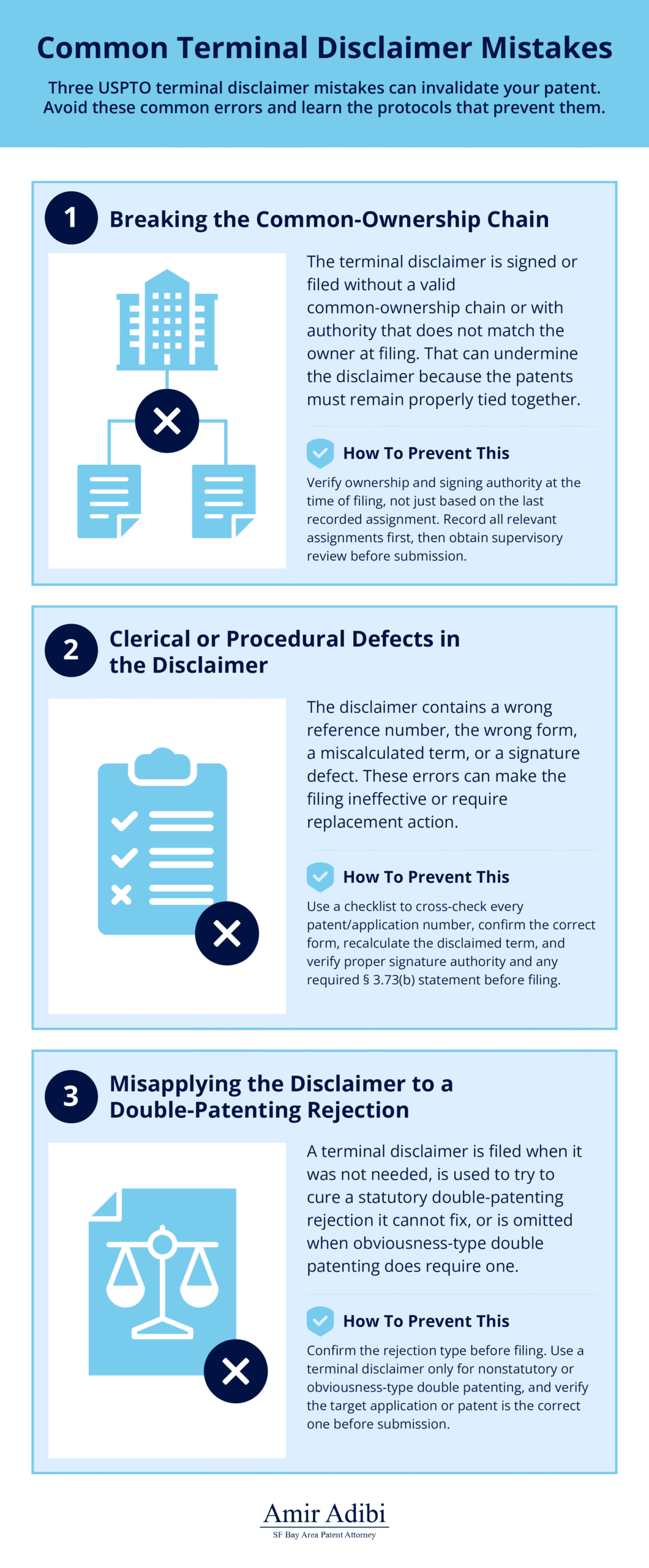
The most common terminal disclaimer mistakes fall into three categories that account for nearly every fatal error. A patent can be rendered permanently unenforceable or invalid by (1) breaking the common-ownership chain the disclaimer depends on; (2) clerical or procedural defects in the disclaimer document itself — a wrong reference number, a miscalculated term, the wrong form, or a signature defect; and (3) misapplying the disclaimer to a double-patenting rejection — filing one that was never required, filing against a statutory rejection it cannot cure, or failing to file when obviousness-type double patenting genuinely demands one. Because an accepted disclaimer cannot be withdrawn or corrected, each of these is effectively irreversible. And because a disclaimer legally ties patents together, a single error can propagate across an entire family.
Key Takeaways
- Common ownership is a continuing obligation, not a one-time box checked at filing. The disclaimer conditions enforceability on common ownership “at the time of enforcement”, so mergers, spin-offs, unrecorded assignments, and licensing can sever it years after a flawless filing.
- Patent term adjustment (PTA) and patent term extension (PTE) behave in opposite ways. A terminal disclaimer extinguishes PTA, and obviousness-type double patenting (ODP) is assessed at the post-PTA expiration date, while PTE survives — the central holding of In re Cellect.
- Name the rejection before you file. A disclaimer can cure ODP but can never overcome statutory double patenting; and a first-filed, first-issued patent cannot be invalidated by a later-filed, later-issued family member (Allergan v. MSN).
- The 2024 proposed enforceability rule is no longer pending. It was withdrawn on December 4, 2024, and the January 2025 fee package kept the flat disclaimer fee rather than the separately proposed tiered structure. Case law, not pending rulemaking, is today’s live risk driver.
- Common terminal disclaimer mistakes are preventable with a disciplined pre-filing checklist and portfolio-wide monitoring of continuing obligations.
Why These Three Mistakes Are Uniquely Catastrophic
Permanent, Irreversible Commitments
Most prosecution errors have an escape hatch. Miss a deadline and you petition to revive; submit the wrong fee and you correct it; draft an ambiguous claim and you amend. A recorded terminal disclaimer has no such hatch. Once accepted, it cannot be withdrawn or unwound, and a defect in it can reach every patent tied to it rather than the single application in front of you.
It helps to hold one distinction in mind throughout. A terminal disclaimer does two separate jobs, and each can fail independently. First, it shortens the patent’s term so the patent expires no later than the reference patent — the function that overcomes an obviousness-type double patenting rejection. Second, it makes the patent enforceable only while it and the reference patent remain commonly owned. Mistake #1 attacks that second job; Mistakes #2 and #3 attack the first. Keeping the two straight is what separates a defensible disclaimer practice from a hopeful one. The governing requirements live in MPEP § 1490, which reproduces both the statutory basis at 35 U.S.C. § 253 and the full text of 37 C.F.R. § 1.321, and they reward practitioners who treat the filing as substantive rather than ministerial.
| You can correct… | You cannot correct… |
| A missed response deadline (petition to revive) | An accepted, recorded terminal disclaimer |
| An incorrect or underpaid fee | Term already surrendered by an over-broad disclaimer |
| An ambiguous claim (amendment) | A disclaimer tied to the wrong reference patent, once relied upon |
| A defective drawing or specification typo | A break in common ownership while the patent is being enforced |
How One Error Infects an Entire Patent Family
The same linkage that makes disclaimers useful makes them dangerous. Tie patents together to clear ODP, and you have also created a path for a single defect to travel. A team managing a large continuation family does not carry that exposure once; the exposure compounds with every disclaimer filed. This is a structural feature of tying patents together, not a rare misfortune.
With that framing in place, the three mistakes follow in order: breaking common ownership, defects in the document itself, and misapplying the disclaimer to a rejection.
Mistake #1: Breaking the Common-Ownership Chain
A terminal disclaimer is a promise that the disclaimed patent and its reference will share an owner for as long as they are enforced. By regulation, the disclaimer must state that the patent “shall be enforceable only for and during such period” that it and the reference remain commonly owned. Break that promise and the patent becomes unenforceable for the period the chain is severed. The error is rarely dramatic; it is usually drift.
Filing without verifying current ownership. The most common version is a disclaimer that affirms ownership as it stood at the original application or the last recorded assignment, rather than at the moment of filing. Intervening transfers, mergers, and reorganizations go unchecked. Because the disclaimer affirms common ownership as a condition of enforceability, an ownership inaccuracy is a substantive defect, not a typo.
Corporate restructuring that severs the link. Mergers, acquisitions, spin-offs, and internal reorganizations routinely divide the ownership of tied patents. A disclaimer that was valid when filed can quietly become defective in effect once the patents land with different entities. The lesson for portfolio managers is unintuitive: every corporate transaction is a reason to audit existing disclaimers, not just to scrutinize new filings.
Unrecorded assignments that open a gap. An assignment that has been executed but not recorded creates a window in which actual ownership and the USPTO record disagree. A disclaimer filed in that window — particularly one signed by an assignee whose interest is not yet of record — may assert common ownership the record cannot support. When an assignee signs, authority must be established with a statement under 37 C.F.R. § 3.73(b), which the USPTO’s own forms flag as a prerequisite. Confirm that every relevant assignment is recorded before the disclaimer goes in, and recognize that unrecorded-assignment gaps are a known line of attack in enforcement disputes.
Losing common ownership over time. Because the obligation runs for the enforceable life of the patent, a later ownership change can undo a disclaimer that was flawless on day one. A point-in-time check at filing is necessary but never sufficient. Common ownership is a continuing obligation — the single reframing most likely to change how a portfolio is managed.
Licensing and encumbrances. Exclusive licenses, security interests, and similar encumbrances complicate the analysis; an exclusive licensee holding all substantial rights can, in some contexts, be treated as an effective owner. Structuring a licensing deal without weighing its disclaimer implications creates hidden exposure, which is why every significant licensing transaction involving tied patents deserves a disclaimer-compliance review.
Post-issuance and M&A drift. Many IP departments close the book on a disclaimer at issuance. That is a lifecycle error. In an acquisition, the obligations travel with the patents, yet acquirers frequently skip auditing them — inheriting disclaimers that are already defective, or tied to patents the seller retained. A post-acquisition separation of commonly owned, tied patents can render them unenforceable the moment it closes. Disclaimer diligence belongs in every acquisition and divestiture, full stop.
If you manage a portfolio through transactions, this is the mistake most likely to surface against you: ownership discrepancies and post-filing common-ownership failures are first-line targets in litigation audits.
Mistake #2: Clerical and Procedural Defects in the Disclaimer Itself
These errors look minor. They are not, because acceptance makes them permanent.
The wrong reference number. A disclaimer ties specific patents by number. Transpose a digit and you tie the wrong patents, or fail to tie the right ones — an error especially easy to make across a continuation family of near-identical numbers. A mandatory cross-check of every cited number, by a second set of eyes, is among the cheapest insurance in this discipline.
Miscalculating the disclaimed term. The disclaimer must surrender any term extending beyond the reference patent’s expiration. Disclaim too much and you permanently give away enforceable life; disclaim too little and you may fail to overcome the rejection. The complication practitioners most often miss is that the two forms of term extension behave in opposite ways when a disclaimer is involved.
| Type of patent term benefit | Survives a terminal disclaimer? | How it interacts |
| PTA (Patent Term Adjustment — for USPTO delay, § 154) | No | A disclaimer cuts off PTA; the disclaimed date controls, and ODP is assessed using the post-PTA expiration date. |
| PTE (Patent Term Extension — for regulatory review, § 156) | Yes | PTE is added on top of the disclaimed date and is preserved. |
This is the heart of In re Cellect, LLC, 81 F.4th 1216 (Fed. Cir. 2023). The Federal Circuit held that ODP is measured at a patent’s expiration date after PTA is added, and that a terminal disclaimer extinguishes the PTA term — distinguishing PTE, which survives a disclaimer under Merck v. Hi-Tech Pharmacal. The hardest lesson in the case was procedural: the court placed the burden on the applicant to file disclaimers proactively, even where the examiner never issued an ODP rejection. By the time the dispute arose, Cellect’s reference patents had expired, so no curative disclaimer was available and the patents were lost. Anticipate ODP; do not wait to be asked.
Using an outdated or incorrect form. The USPTO updates its forms, and a superseded template can produce a defective filing. The form family is also more nuanced than the common shorthand suggests. It varies along three axes:
| Axis | Distinction |
| /25 vs. /26 | Status of the reference: a /25 form references a co-pending application; a /26 form references an issued prior patent. |
| Base vs. “a” variant | Status of the instant case being disclaimed: base forms (SB/25, SB/26) are filed in a pending application; the “a” variants (SB/25a, SB/26a) are filed in an already-issued patent. |
| SB vs. AIA | Pre-AIA filings use the SB series; AIA filings (effective filing on or after Sept. 16, 2012) use PTO/AIA/25 and AIA/26. |
Framing the choice as an “ownership scenario” is wrong; the distinction is application and patent status. In practice, the USPTO’s eTerminal Disclaimer tool in Patent Center guides the filer through a compliant web-based flow and auto-processes the disclaimer immediately when all requirements are met, which is the most reliable way to reduce form-selection error. A form mismatch may be accepted initially and challenged later as failing 37 C.F.R. § 1.321.
Signature and authorization defects. Under 37 C.F.R. § 1.321(b), a disclaimer must be signed by a proper party — the applicant, the assignee of record, or an attorney or agent of record. Signing as an assignee before recordation, or having a corporate officer sign without established authority, produces a defective disclaimer; an assignee signer must support authority with the § 3.73(b) statement noted above. Opposing counsel scrutinize signatures as a matter of routine, so a firm-wide signature-verification step earns its place on the checklist.
Mishandling deficiency notices. A deficiency notice carries a narrow response window. Answer it without curing the specific defect identified and you compound the problem; leave it unresolved and the disclaimer can be treated as never filed, leaving the ODP rejection live. The USPTO’s acceptance is not automatic, and silence is not acceptance — a non-compliant disclaimer can be refused recordation, so confirm acceptance and recordation affirmatively rather than assuming it.
Mistake #3: Misapplying the Disclaimer to a Double-Patenting Rejection
A terminal disclaimer has one correct use. Reaching for it in the wrong situation — or failing to reach for it in the right one — is itself the error. Start by categorizing the rejection.
| Double-patenting rejection | Obviousness-type (ODP) | Statutory (same-invention, § 101) |
| Basis | Judicially created; claims not patentably distinct from a commonly owned earlier patent. | Two patents claim the same invention. |
| Curable by a terminal disclaimer? | Yes | No |
| Correct response | File a disclaimer if analysis confirms it’s needed. | Amend or cancel claims; a disclaimer cannot fix it. |
Filing a disclaimer that was never required. Not every ODP rejection demands a disclaimer. Arguing the merits, amending claims, or challenging the reference are real alternatives, and a claim-by-claim ODP analysis should precede any decision to file. A reflexive disclaimer is expensive precisely because of the PTA interaction above — it can surrender hard-won adjustment term the patent was lawfully entitled to keep.
Filing against a statutory rejection. A terminal disclaimer cannot overcome statutory double patenting; MPEP § 804 states it plainly. Filing one wastes the response and, worse, leaves the rejection live while the matter appears closed. Every response begins with correctly naming the rejection type.
Failing to file when ODP genuinely requires it. The mirror-image mistake is letting an ODP rejection sit in the belief it can be argued away. Unresolved, it can lead to abandonment or a later validity challenge. Evaluate each application on its own and file at the level where the rejection is made.
Assuming a parent’s disclaimer protects every child. It does not. Each continuation, divisional, or continuation-in-part is a separate application that must answer its own ODP rejections. There is an important nuance here that cuts in the patentee’s favor: in Allergan USA, Inc. v. MSN Laboratories Private Ltd., 111 F.4th 1358 (Fed. Cir. 2024), the Federal Circuit limited Cellect by holding that a first-filed, first-issued patent cannot be invalidated under ODP by a later-filed, later-issued family member — even where PTA causes the parent to expire later than the child. The original patent generally sets the family’s maximum period of exclusivity, and a child cannot be turned backward against its parent. The real exposure runs forward, to later-issued children that depend on, but are not automatically shielded by, a parent’s disclaimer. A systematic audit of every active continuation is the most reliable safeguard against divisional and continuation application mistakes.
Continuation strategies that create needless entanglements. Continuations with insufficiently differentiated claims invite ODP rejections and the disclaimer obligations that follow. Evaluating the ODP implications of each continuation’s claim scope before filing — and differentiating claims deliberately — reduces disclaimer dependency across the whole portfolio.
How These Errors Surface in Litigation and Post-Grant Proceedings
How Adversaries Audit Your Disclaimers
A defect never noticed during prosecution can anchor a defense years later. Opposing counsel run disclaimer audits looking for exactly the failures above: ownership discrepancies, incorrect reference patents, signature defects, and post-filing common-ownership breaks. Cellect itself reached the Federal Circuit through ex parte reexaminations requested by an accused infringer, asserting an ODP theory the examiner had never raised during prosecution. Understanding that method — that someone will eventually read your disclaimer adversarially — is the first step to hardening against it.
Two Failure Modes: Invalidity vs. Unenforceability
Precision matters here, because disclaimer defects bite in two doctrinally different ways.
The first is invalidity. An unresolved or mishandled ODP rejection can leave claims invalid for double patenting — the Cellect fact pattern. Some validity problems can be addressed through reissue or reexamination, but once a needed disclaimer is no longer available because the reference patent has expired, the defect is effectively permanent and no reissue or reexamination will save it — a result confirmed both by the Cellect outcome and by MPEP § 1490, which states that a disclaimer filed after the reference patent’s expiration is not effective to obviate the rejection.
The second is unenforceability. A break in the common-ownership chain renders the patent unenforceable for the period the chain is broken — a consequence flowing from the disclaimer’s own terms, not from inequitable conduct. There is no single “unenforceability doctrine” that governs both modes; describing them accurately is what keeps the analysis defensible.
For teams expecting a fight, the goal is to harden the portfolio before an adversary audits it, not after.
The Current Regulatory Landscape, Including the Withdrawn 2024 Rule
Be exact about where the rules stand, because outdated assumptions here cause real errors. In May 2024 the USPTO proposed a rule that would have made a disclaimer-tied patent unenforceable if any claim in a linked patent were later held unpatentable or invalid over prior art. That proposal was withdrawn on December 4, 2024, leaving the status quo intact. In a separate fee rulemaking, the Office had also floated escalating, tiered terminal-disclaimer fees; the final January 2025 fee package declined to adopt them and kept the flat disclaimer fee. Current practice under 37 C.F.R. § 1.321(c) and (d) is unchanged. No rule change is in effect or imminent — the USPTO’s withdrawal notice confirms it.
Congressional concern about patent thickets persists, and future rulemaking or legislation remains possible. But the live risk driver today is case law — In re Cellect and Allergan v. MSN — not a pending rule. Consult MPEP § 1490 in its current form for every USPTO terminal disclaimer filing; relying on institutional memory is itself a systemic error.
With the stakes clear, the answer is not vigilance in the abstract but a protocol that makes these mistakes hard to make.
Building a Systemic Defense: A Protocol to Prevent These Mistakes
The Mandatory Pre-Filing Checklist
The most effective prevention tool is a checklist that no USPTO terminal disclaimer leaves the building without. At minimum it should require sign-off on:
- Ownership verification — confirmed as of the moment of filing, not the last recorded assignment.
- Form selection — correct on all three axes (reference status, instant-case status, AIA vs. pre-AIA).
- Reference-number accuracy — every cited number independently cross-checked.
- Term calculation — with the PTA-versus-PTE distinction made explicit.
- Signature authority — proper signatory under § 1.321(b), plus a § 3.73(b) statement where an assignee signs.
- Assignment recordation — all relevant assignments recorded before filing.
- Supervising-practitioner sign-off — a named reviewer before submission.
Treated as mandatory, a checklist of this kind is a well-established way to reduce deficiency notices and post-issuance failures.
Portfolio-Wide Monitoring for Continuing Obligations
Because the obligations never end, monitoring cannot either. Docketing should track ongoing common-ownership requirements, not just response deadlines, and audits should run at least annually and on any significant corporate event.
| Triggering event | Required disclaimer action |
| Merger, acquisition, or spin-off | Audit all tied patents for common-ownership continuity. |
| Executed assignment | Confirm recordation; re-check any disclaimer relying on it. |
| New license or security interest | Review common-ownership impact on tied patents. |
| New continuation or divisional filing | Run an independent ODP analysis; do not assume parent coverage. |
| Portfolio acquisition or divestiture | Mandatory disclaimer diligence before close. |
Training and Knowledge Management
Most of these mistakes begin as knowledge gaps. Invest in targeted training on disclaimer requirements, the common failure modes, and current developments such as Cellect and its evolving limits. Capture the lessons from deficiency notices, litigation challenges, and audit findings, and build a culture that treats a disclaimer filing with the same gravity as claim drafting — because the consequences of getting it wrong are comparable.
Putting It Together
High-value families deserve a structured, documented review applied at every stage: pre-filing ownership verification, form-currency checks, reference cross-checks, term review with the PTA/PTE distinction explicit, and post-filing confirmation of acceptance and recordation. Fold disclaimer compliance into every major transaction, license, and acquisition. The shift that prevents all three mistakes is one of mindset — treating disclaimer management as a specialized discipline rather than routine administration.
All three mistakes are preventable. None of them turns on a doctrine a competent practitioner doesn’t already know; each turns on whether a disciplined review caught it in time. The defect that ends a patent is almost always the one no one was assigned to look for. Put the protocol in place before an adversary supplies the audit for you.
This article is provided for general informational purposes and does not constitute legal advice. It does not create an attorney-client relationship, and outcomes depend on the specific facts of each matter. Consult qualified patent counsel regarding your particular situation.