
 June 9, 2026
 0 comments
A claim narrowed in a 2019 office action. Five words added to escape an obviousness rejection on a Tuesday afternoon. The rejection is cleared, the parent issues, and the file closes. Six years later, in a deposition, a defense expert reads those five words back to the court. Every continuation or divisional filed since has just been quietly capped.
That sequence — small decision, defensible at the time, irreversible in hindsight — is the shape of most continuation and divisional application failures. Dramatic blow-ups are rare; accumulated tactical compromises are not. What follows are the five most common pitfalls in continuation and divisional applications that destroy portfolio value, the doctrinal mechanisms behind each one, and an audit framework you can run before the next filing.
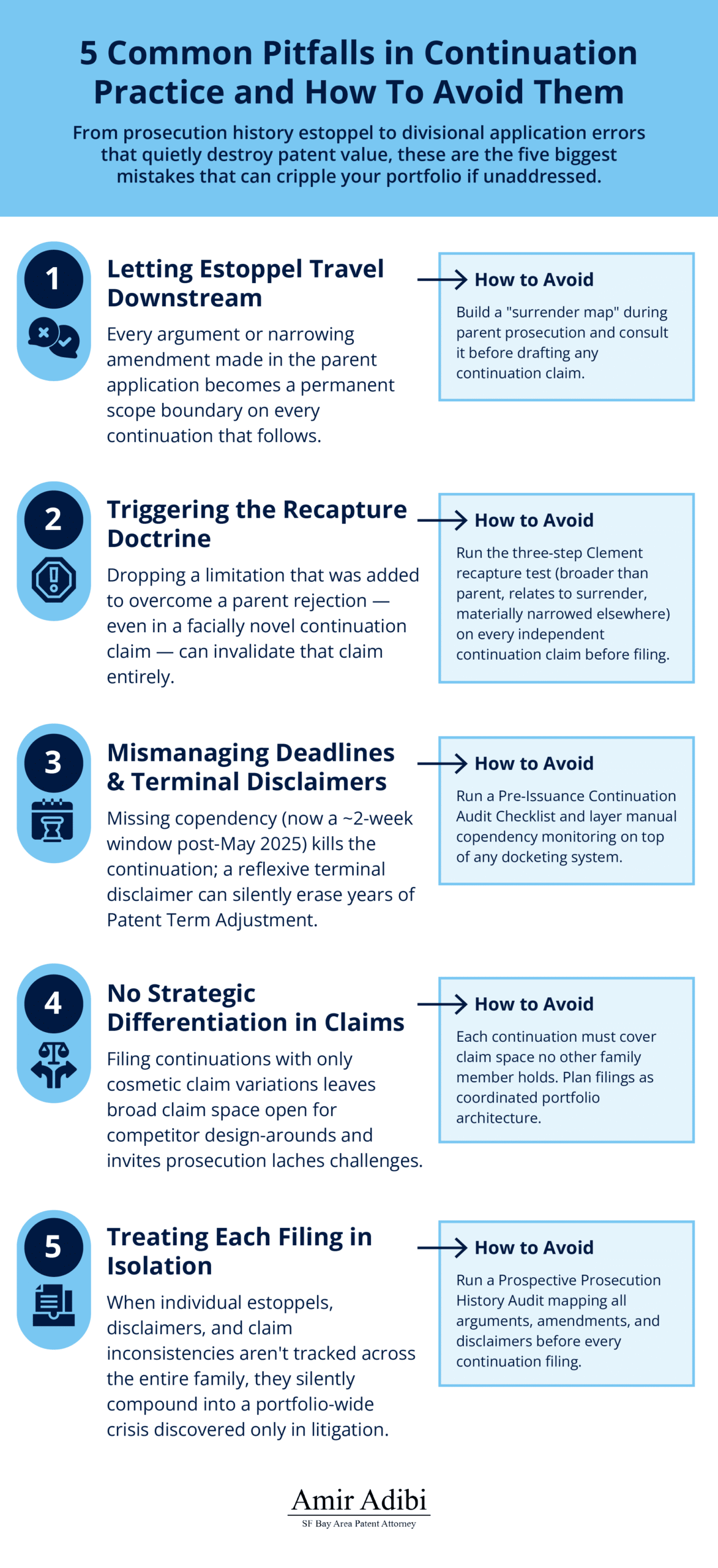
Mistake #1: Letting Prosecution History Estoppel Travel Downstream Into Every Continuation and Divisional Application
Before any continuation or divisional application is filed, the parent application has already written its rules.
What It Is
Prosecution history estoppel is brutal in practice: any argument or amendment used to overcome a rejection in the parent automatically becomes a permanent boundary on every claim in every downstream family member. The record speaks for the family.
It arises in two ways. Amendment-based estoppel occurs when you narrow a claim to overcome a rejection — you’ve surrendered the territory between the original claim and the amended one. Argument-based estoppel occurs when you distinguish prior art in writing without changing a single word of the claims. The remark is enough. The Supreme Court grounded the doctrine in Festo: the PTO’s prosecution record fixes the scope of what the patent owner gave up, and that scope cannot later be reclaimed through infringement litigation.
Why It’s Dangerous
The mechanism most practitioners underweight is the Festo presumption. Any narrowing amendment made for a reason related to patentability creates a presumption of complete surrender of the territory between original and amended claim language. The burden shifts to the patent owner to rebut that presumption later, and the available pathways (unforeseeability, tangential relation, “other reasons”) are narrow.
A five-minute decision to clear a rejection by tightening one phrase becomes a presumption your successors fight in court a decade later.
Certain language patterns trigger surrender almost reflexively:
- “The present invention requires…”
- “Unlike the prior art, the invention always includes…”
- “The claims are limited to…”
- “The invention is distinguished by…”
Each reads like reasonable advocacy on the day it’s written. Each functions as a definitional limitation on the day it’s litigated.
How It Shows Up in Practice
A parent claim is narrowed to overcome a §103 rejection. Years later, a continuation drafted by a different attorney attempts broader scope on the same embodiment. The defendant cites the parent prosecution history. Game over.
Or: a sweeping “what the invention is not” argument made to clear a rejection becomes a permanent limitation across the entire family, including continuations not yet filed when the argument was made.
Divisional applications are especially vulnerable here because they’re often filed late in prosecution (in response to restriction requirements), meaning the parent’s estoppel has already accumulated significant scope boundaries before the divisional is even drafted.
How to Avoid It
Recognize the dangerous language for what it is:
| Estoppel Trigger Language | Safer Alternative |
| “The present invention requires X” | “In this embodiment, X is used to…” |
| “The claims are limited to” | “In the disclosed configuration…” |
| “Unlike the prior art” | “The cited reference does not disclose…” |
| “The invention always includes” | “In the depicted embodiment” |
| “Critical to the invention is” | “One feature of this embodiment is” |
| “It is essential that” | “In one implementation” |
Beyond language hygiene: treat every parent-application amendment and argument as a permanent boundary marker for the entire family. Document a surrender map during parent prosecution — every limitation added, every argument made, with the prior art reference each was meant to distinguish — and consult it before drafting any claim. This is among the highest-leverage disciplines in continuation practice. Where possible, overcome rejections through evidence — declarations under 37 CFR §1.132, comparative test data — rather than written argument. Evidence narrows the rejection without surrendering claim scope.
Understanding the prior art landscape that drives these amendments is the first defense. See our breakdown of 35 U.S.C. §102 novelty and prior art.
Mistake #2: Triggering the Recapture Doctrine With Claims That Reach Too Far Back
If estoppel is the boundary, recapture is the wall. Crossing it doesn’t narrow your claims, it invalidates them entirely.
What It Is
The recapture doctrine prevents applicants from reclaiming subject matter surrendered during parent prosecution. The textbook scenario: a limitation is added to a parent claim to overcome a rejection, then dropped in a continuation chasing broader coverage.
Courts apply a three-step test rooted in In re Clement and restated by the Federal Circuit in North American Container. Step one: is the claim broader in some respect than the parent? Step two: does the broader aspect relate to subject matter surrendered during parent prosecution? Step three: was the claim materially narrowed in other respects to avoid the recapture rule? Run all three before filing.
While recapture bites hardest where the disclosure base is identical to the parent, it still applies to divisionals when limitations are dropped to chase broader coverage.
Why It’s Dangerous
Courts interpret “surrendered” more broadly than practitioners tend to anticipate in the moment. The doctrine is most aggressive in continuation claims where the disclosure base is identical to the parent, so there’s no new-matter argument to soften the analysis. Continuation-In-Part applications (CIPs) and divisionals carved under §121 have more room.
The line between tangentially related amendments (which can escape recapture) and directly related amendments (which can’t) is far less clear during prosecution than in hindsight litigation. A limitation added to clear a §103 rejection on an asserted novel feature is almost always directly related.
How It Shows Up in Practice
A continuation claim appears novel on its face but is silently invalidated because it omits a limitation added to escape rejection years earlier. The claim and the prior art look fine together; the prosecution history is what kills it.
Or — the textbook recapture pattern — a “broadening” continuation is filed to recapture commercial-grade scope after a parent issued narrower than hoped. That is precisely the move the doctrine was designed to prevent.
How to Avoid It
Apply a formal recapture analysis to every independent continuation claim before filing. Walk through the three Clement steps explicitly — make it a checklist item, not a vibe. Maintain the surrender map from Mistake #1; recapture analysis depends on it.
When a continuation claim drops or generalizes a limitation present in the parent, document the strategic justification contemporaneously. Written reasoning helps support a tangential-relation argument later. Reconstructed rationale almost never works.
For high-value continuations, route the claim through a fresh-eyes review by counsel not involved in parent prosecution. The original team helped accumulate the estoppel; they’re the worst-positioned reviewer of it.
Mistake #3: Divisional Application Deadlines, Disclosure Limits & Terminal Disclaimer Traps
Doctrine isn’t the only enemy. Some continuation mistakes are purely procedural, and just as irreversible.
What It Is
A divisional application is a type of continuing patent application filed when the USPTO issues a restriction requirement because the parent discloses multiple inventions. It shares the parent’s disclosure and priority date but claims a separate invention that was originally disclosed but not examined.
All continuing applications face three procedural traps, each reversible only if caught before it happens: copendency failures, specification disclosure pitfalls, and reflexive terminal disclaimers. Divisional applications face heightened copendency risk because restriction requirements often arrive late in prosecution, narrowing the filing window.
Copendency failures. A continuation must be filed before the parent issues or is abandoned, per 35 U.S.C. §120. Miss the window, no continuing application.
Specification disclosure pitfalls. A continuation is permanently bound to the parent specification. Claim elements not adequately supported in the original disclosure are fatally vulnerable on written description and enablement grounds under 35 U.S.C. §112(a).
Terminal disclaimer misuse. Filing a terminal disclaimer to overcome obviousness-type double patenting permanently ties the continuation’s enforceability to the parent patent’s validity and shared ownership.
Why It’s Dangerous
Copendency is an unforgiving deadline with no cure mechanism. Most missed-copendency failures trace to the same short window: once the USPTO mails the Issue Notification, the patent typically issues on the next available Tuesday. Effective May 13, 2025, the USPTO compressed that window from roughly three weeks to approximately two, meaning the practical filing buffer for last-minute continuations is now materially shorter than the playbook many firms still rely on. The USPTO’s compressed issue notification window makes this even tighter for divisionals. A divisional application filed in response to a restriction requirement must be filed before the parent issues, but examiners often issue restriction requirements late in prosecution. This creates a narrow window where practitioners assume they have more time than they actually do.
Specification limits matter because the parent’s disclosure is the ceiling. Under the Ariad Pharms. v. Eli Lilly possession standard, the parent must show the inventor was in possession of the claimed invention at filing. Generic functional language is rarely enough. If the parent didn’t show possession of the embodiment the continuation now claims, the continuation loses written description support and falls.
Terminal disclaimers create catastrophic portfolio vulnerability in three ways most practitioners haven’t fully priced. First, a single invalidity finding on the parent collapses the entire chain of disclaimed continuations — they fall together because the disclaimer made them rise together. Second, and most underestimated, terminal disclaimers can wipe out Patent Term Adjustment under 35 U.S.C. §154(b) — the additional patent life the USPTO grants when its own delays push prosecution past statutory benchmarks. The Federal Circuit confirmed in In re Cellect that §154(b)(2)(B) bars PTA for PTO-attributable delays past the date specified in a terminal disclaimer. A reflexive disclaimer can erase years of restored term, which is where silent value destruction lives. Third, terminal disclaimers cure obviousness-type double patenting, a judge-made doctrine. They do not cure statutory double patenting under §101.
How It Shows Up in Practice
A high-value parent issues unexpectedly fast. The continuation that was on the to-do list is now impossible.
A breakthrough embodiment emerges post-filing. The parent has no prophetic example or alternative embodiment to support it. The continuation loses priority on that element or becomes a CIP (Continuation-In-Part), forfeiting the parent’s priority date for the new matter.
A terminal disclaimer is filed reflexively without considering whether claim differentiation arguments could have preserved independent enforceability and PTA. Nobody calculates the term being given up.
How to Avoid It
Build a Pre-Issuance Continuation Audit Checklist and run it before every filing:
- Has the issue fee been paid on the parent? (The copendency clock is now running — and shorter than it used to be.)
- Is the continuation draft ready, with claims surrender-mapped against the parent prosecution history and §121 restriction requirement documentation for any divisional application filed in response to a restriction?
- Has written description support for every claim element been verified against the parent under the Ariad possession standard?
- Have terminal disclaimer alternatives — particularly claim differentiation arguments — been evaluated against any double-patenting rejection?
- Has Patent Term Adjustment been calculated for the parent, so the cost of a terminal disclaimer is visible before it’s filed?
- Is the family’s surrender map up to date, and has it been consulted for recapture exposure?
- Have all prior art references known through the filing date been queued for an Information Disclosure Statement?
Layer manual copendency monitoring on top of any docketing system — automated flags fail on high-value assets at the wrong moment, and the post-May 2025 compression of the Issue Notification window has narrowed the margin for error. Draft parent specifications with prophetic examples and broader functional language to support future continuation strategies. Evaluate terminal disclaimer alternatives before filing; the reflex disclaimer is rarely the best move, just the fastest.
All of this is part of broader patent portfolio analysis and should be standing practice, not an exception.
Mistake #4: Drafting Claims Without Strategic Differentiation From the Parent (or From Each Other)
A continuation that doesn’t capture new strategic ground isn’t a defense, it’s an invitation.
What It Is
Filing continuation claims merely cosmetically different from parent claims wastes prosecution resources while providing no meaningful additional coverage. Three failures compound: no deliberate differentiation strategy across the family, extended prosecution timelines that risk prosecution laches, and failure to account for prior art emerging during the continuation window, including the applicant’s own publications.
Why It’s Dangerous
Claim clustering — every continuation claim in the family covering the same narrow embodiment — leaves broad claim space unprotected and available for competitor design-arounds. You’ve paid for the same patent five times and bought no additional coverage.
Prosecution laches can render continuation patents unenforceable when courts find applicants unreasonably delayed prosecution for strategic timing. The Federal Circuit reaffirmed the doctrine in Hyatt v. Hirshfeld (2021), holding that unreasonable and unexplained delay in prosecution — assessed under the totality of the circumstances — can render an otherwise valid patent unenforceable, and that the defense is available to the USPTO itself in §145 actions. The judicial skepticism that targeted “submarine patents” in the pre-GATT era didn’t disappear when the term rules changed, it migrated into the laches inquiry and is alive in current litigation.
Prior art emerging between the parent’s filing date and the continuation’s prosecution can devastate continuation claims not entitled to the parent’s priority date. New claim elements not literally supported in the parent disclosure can lose priority date entitlement element-by-element, exposing them to intervening art, including the applicant’s own publications and product launches. Disclosure via an Information Disclosure Statement is mandatory; under 37 CFR §1.56, failure can trigger inequitable conduct allegations on top of invalidity, with the consequence of rendering the patent unenforceable.
How It Shows Up in Practice
Continuation after continuation filed with minimal differentiation while a competitor unknowingly invests in a potentially infringing product. Courts increasingly treat this pattern as a laches red flag.
All continuations in the family cover variants of the same embodiment. The competitor designs around the embodiment entirely and operates freely in adjacent unclaimed space — space the family could have covered if anyone had architected the claims with that gap in mind.
Divisional applications are particularly at risk here because they’re often filed reactively (in response to restriction requirements) rather than proactively, making strategic claim differentiation overlooked.
How to Avoid It
Plan continuation claims as part of coordinated portfolio architecture, not reactive responses to examiner pressure. Every new continuation should answer one question: what claim space is this filing taking that no other family member covers?
Document legitimate prosecution justifications proactively to rebut potential laches arguments. Contemporaneous strategic notes carry weight that reconstructed rationale never matches.
Conduct a continuation-specific prior art landscape review for each new claim scope. Don’t inherit the parent’s prior art analysis without verification — the world has moved on since the parent was filed, and the applicant has often been the one moving it. Verify priority date entitlement element-by-element, especially for any claim element not appearing verbatim in the parent’s original disclosure.
Mistake #5: Failing to Audit the Entire Patent Family’s Prosecution History as a Unified Whole
The first four mistakes are individual decisions. This one is a management failure, and it’s the reason the others compound.
What It Is
Treating each application in a continuation family as an isolated prosecution record rather than as a single, unified interpretive document. Courts read patent families as one record. So do defendants. The absence of a systematic, cross-application prosecution history audit lets individual estoppels, disclaimers, and inconsistencies accumulate into a portfolio-wide claim scope crisis, typically discovered only during litigation when nothing can be done about it.
Why It’s Dangerous
Claim terms defined or narrowed during parent prosecution bind the interpretation of identical terms in every continuation claim, even when the drafter intended different scope. The family is one document.
Inconsistencies between continuation prosecution histories give defendants direct ammunition. Courts increasingly treat contradictions inside a family as evidence the patent owner’s claim construction is unreliable. This is one of the strongest doctrinal arguments for the audit framework that follows.
Then there’s the sunk cost trap: practitioners continue down a narrowing claim path because reversing course feels more costly than the cumulative damage being done. It almost never is.
How It Shows Up in Practice
A litigation discovery exercise — five years into enforcement — reveals that a phrase narrowed in a 2019 office action response has silently capped every claim filed since. By then, the value is already lost.
Two continuations in the same family take subtly different positions on a key claim term during prosecution. A defendant later argues the patent owner cannot consistently construe the term, and wins.
Divisional applications compound this risk because they’re often prosecuted by different attorneys than the parent, increasing the chance of inconsistent positions going undetected until litigation.
How to Avoid It
Run a Prospective Prosecution History Audit — four steps, done before each continuation filing and at scheduled intervals for high-value families:
- Map every argument, amendment, and disclaimer across all family members.
- Compare the cumulative record against the claim scope intended for future filings.
- Flag accumulated estoppels and inconsistencies before they propagate.
- Document the audit itself as evidence of good-faith, structured prosecution strategy.
Treat prosecution history review as ongoing patent portfolio strategy, not a pre-litigation discovery exercise. By the time litigation forces it, the audit has already failed its purpose. Bring fresh prosecutorial perspective to continuation drafting; the team that built the record is the worst-positioned reader of it. Regular audits also create documented evidence to rebut prosecution laches and inequitable conduct allegations.
Protecting Continuation Value Starts Before the First Mistake
The most damaging common pitfalls in continuation practice are rarely visible the day they happen. A narrowing amendment. A persuasive remark. A reflexive disclaimer. A continuation drafted under deadline without consulting the surrender map. Each is defensible alone. Together, they form the legal dead-end every patent owner fears — the moment in litigation when the prosecution history closes every door at once.
The pattern is preventable. Treat the patent family as a single strategic record, not a sequence of isolated filings. Maintain a surrender map. Calculate the cost of a terminal disclaimer before reaching for it. Run a Prospective Prosecution History Audit before every continuation or divisional filing, and at a standing cadence for the assets that matter most.
If you suspect your portfolio carries any of these vulnerabilities, a structured prosecution history audit is the fastest way to find out. Contact our team for a continuation or divisional portfolio review.