
 November 6, 2026
 0 comments
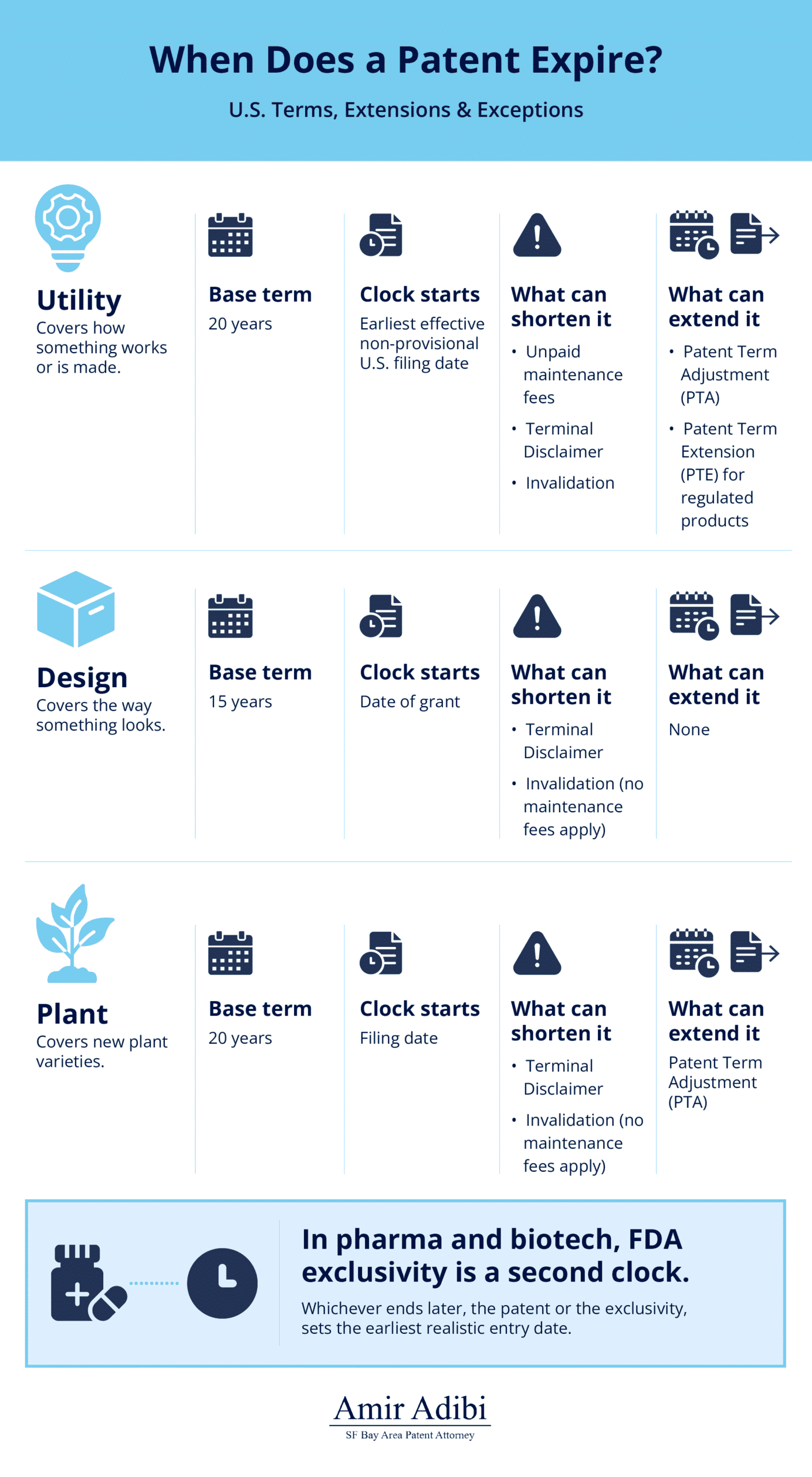
A U.S. utility patent generally expires 20 years after its earliest effective non-provisional filing date, as long as its maintenance fees are paid. Design patents last 15 years from grant, and plant patents last 20 years from filing. That is the rule for when patents expire.
The date that matters, though, is the day a competitor can actually launch. Term adjustments, extensions, fee lapses, revivals, regulatory exclusivities and related patents can move that date by months or years, in either direction.
Get the date wrong as a patent holder and you meet a revenue cliff you never budgeted for. Get it wrong as an entrant and you either wait while others launch or launch into a lawsuit.
U.S. Patent Terms at a Glance
| Patent type | Base term | Clock starts | What can shorten it | What can extend it |
| Utility | 20 years | Earliest effective non-provisional U.S. filing date | Unpaid maintenance fees, terminal disclaimer, invalidation | Patent Term Adjustment (PTA), Patent Term Extension (PTE) for regulated products |
| Design | 15 years | Date of grant | Terminal disclaimer, invalidation (no maintenance fees apply) | None |
| Plant | 20 years | Filing date | Terminal disclaimer, invalidation (no maintenance fees apply) | Patent Term Adjustment (PTA) |
Key Takeaways
- The core answer: A U.S. utility patent generally expires 20 years from its earliest effective non-provisional filing date, if maintenance fees are paid. Design patents last 15 years from grant; plant patents last 20 years from filing. A provisional application does not start the clock.
- Five factors most often move the date: PTA, PTE, terminal disclaimers, maintenance fee status and post-grant challenges.
- Expiration is not freedom to operate. Related patents, regulatory exclusivities and trademarks can still block a launch.
- In pharma and biotech, FDA exclusivity is a second clock. Whichever ends later, the patent or the exclusivity, sets the earliest realistic entry date.
- The cliff is steep but predictable. Brands facing generics keep only a small share of their volume after a year, and prices fall with each new competitor.
- Holders should plan 3–5 years out with an expiration calendar tied to revenue.
- Entrants should verify the date in official records and clear the whole patent family before committing launch spend.
Jump to:
- Protecting a portfolio → For Patent Holders
- Pharma or biotech → Drug Patent Expiry
- Planning a launch → For Market Entrants
Navigating the Patent Expiration Landscape: Risks, Rights, and Revenue Strategies
Every expiration question comes down to three things: how the term is calculated, what can move it, and what “expired” actually means.
Understanding Patent Term Limits and What Expiration Actually Means
A patent’s 20-year clock starts the day the application is filed, not the day the patent is granted. That is why few patents ever protect a product for anything close to 20 years.
When the clock starts. Under 35 U.S.C. § 154, the term runs 20 years from the earliest effective non-provisional filing date. A continuation or divisional usually inherits its parent’s filing date. The later patent therefore usually expires on the same day as the parent, even if it was granted a decade later. Provisional applications sit outside the count, so the year a company spends refining a provisional costs it no term at all.
Why effective exclusivity is shorter. The clock runs from filing, but rights are enforceable only after grant. Average total pendency at the USPTO was 27.9 months in February 2026, so two years or more of term are often gone before a patent issues. In regulated industries, the term also keeps running through clinical trials and FDA review. A drug patent filed early in discovery can reach pharmacy shelves with much of its term already spent.
Patent Term Adjustment vs. Patent Term Extension. The two names sound alike but do different jobs:
- Patent Term Adjustment (PTA), under 35 U.S.C. § 154(b), compensates for delays the USPTO caused. It can add hundreds of days, minus any delay the applicant caused. The PTA figure is printed on the face of the patent.
- Patent Term Extension (PTE), under 35 U.S.C. § 156, restores time lost to regulatory review of drugs, biologics, medical devices and certain food and color additives.
- It adds up to 5 years.
- Only one patent per approved product can be extended.
- The remaining term after approval is capped at 14 years.
- The owner must apply within 60 days of FDA approval. Miss that window and the extension is gone for good.
Terminal disclaimers. A terminal disclaimer is a filing that ties a patent’s expiration date to an earlier patent, usually to overcome a “double patenting” rejection. A patent subject to one expires no later than the patent it references, whatever its own PTA says.
There is also a less obvious condition. When a terminal disclaimer is filed to overcome a double-patenting rejection, the disclaimed patent is enforceable only while it stays under common ownership with the referenced patent. Sell one without the other, and the buyer may own a patent it cannot enforce.
Early termination for unpaid maintenance fees. Patent maintenance fees on utility patents fall due 3.5, 7.5 and 11.5 years after grant. Each due date opens a six-month grace period, during which the fee can still be paid with a surcharge. Miss the grace period, and the patent expires.
That expiry is not always final. The owner can petition the USPTO to accept the late payment if the delay was unintentional. A final rule published June 24, 2026 (91 FR 37826) made that harder for petitions filed on or after August 13, 2026. Petitions filed more than one year after the patent expired now need additional information about the circumstances of the delay and a higher-tier petition fee. Under the previous rule, that threshold was two years. Anyone who started using the invention during the lapse may be protected by intervening rights under 35 U.S.C. § 41(c).
The four ways a patent ends:
| Status | What happened | Can it come back? | Can others use the invention? |
| Expired | The full term, including any PTA or PTE, ran out. | No | Yes, subject to other patents and rights still in force. |
| Lapsed | A maintenance fee went unpaid. | Possibly, by petition for unintentional delay | Yes, at some risk; intervening rights may protect those who relied on the lapse. |
| Invalidated | A court or the Patent Trial and Appeal Board (PTAB) held the claims invalid. | Only if reversed on appeal | Yes, for the invalidated claims. |
| Abandoned or disclaimed | The owner gave up the patent or specific claims. | No | Yes, for the abandoned or disclaimed claims. |
Why expiration does not equal freedom to operate. The patent you are watching is rarely the only lock on the door. Continuations, improvement patents, process patents, FDA exclusivities, trademarks and trade dress can each keep practical exclusivity alive past the base term. Expiry removes one lock and tells you nothing about the others.
How to Calculate a Patent’s Real Expiration Date
Finding a patent expiration date you can rely on takes eight checks, and errors usually come from skipping the last five. The USPTO’s own rules on term are in MPEP § 2701.
- Identify the patent type and its earliest effective non-provisional filing date. Check every priority and benefit claim. A continuation filed in 2018 may claim a 2012 parent, and the 2012 date controls.
- Add the base term. That is 20 years from filing for utility and plant patents, or 15 years from grant for design patents.
- Add any PTA. The number of days is printed on the face of the patent and recorded in USPTO records.
- Check for a terminal disclaimer. If one exists, the patent cannot outlast the patent it references, so look up that date too.
- Check maintenance fee status. The patent will be paid up, in the grace period, lapsed or reinstated. Confirm which in USPTO Patent Center.
- Check for a granted PTE. This applies to drugs, biologics, medical devices, and certain food and color additives.
- Check for post-grant events. These include reissue, reexamination certificates, PTAB decisions, court rulings of invalidity and disclaimed claims. Any of them can narrow or erase claims before the date arrives.
- For regulated products only, layer in FDA exclusivities. These run on their own clock, independent of the patent (see Drug Patent Expiry).
Work from official sources: USPTO Patent Center, USPTO Patent Public Search, and the FDA Orange Book and Purple Book. Expiration dates shown by search tools are estimates. Even the USPTO’s own patent term calculator is offered only as an educational tool, not as an official USPTO determination. An estimate can quietly miss a PTE, a terminal disclaimer or a fee lapse.
Worked example (hypothetical)
- Utility patent filed March 1, 2010, with no earlier priority claim
- Base expiry: March 1, 2030
- PTA on the face of the patent: 214 days → October 1, 2030
- Terminal disclaimer: none
- Maintenance fees: all three paid
- PTE: not applicable
Calculated expiration: October 1, 2030. Skip the 11.5-year fee and the same patent ends years earlier, at the close of the grace period.
The Revenue Cliff: What Patent Holders Face When Exclusivity Lapses
When exclusivity ends for a small-molecule drug, the brand usually loses most of its prescriptions within a year. Outside pharma, the decline is generally slower and leaves more room to negotiate.
Real case example: Lipitor. On November 30, 2011, Lipitor lost its U.S. exclusivity. It had earned Pfizer about $9.6 billion worldwide that year, roughly 14% of the company’s total revenue (Pfizer 2011 Annual Report). By the second quarter of 2012, U.S. branded Lipitor revenue had fallen to $296 million, from $1.4 billion a year earlier (Pfizer Q2 2012 results). That is a year-over-year drop of nearly 80%, seven months after exclusivity ended.
The steepest fall came after multi-source generic competition began in May 2012, about six months after the first generic launched. Pfizer softened the blow with an authorized generic sold through a partner, a tactic covered under defensive strategies.
Lipitor was not an outlier. A peer-reviewed study found that brand-name drugs facing generic entry kept, on average, only 16% of their unit volume a year later, and the biggest sellers kept just 11% (Grabowski, Long & Mortimer, Journal of Medical Economics, 2014). Those figures count prescriptions, not dollars. How much revenue goes with those prescriptions depends on pricing, contracts and how much volume the brand holds on to.
Erosion differs by sector:
| Sector | Typical speed of erosion | Main driver |
| Small-molecule pharmaceuticals | Fast, often within months | State substitution laws and payer formularies favor generics automatically. |
| Biologics | Slower and more gradual | Manufacturing complexity, interchangeability rules and prescriber habits. |
| Electronics and technology | Moderate | Fast product cycles; next-generation features often matter more than the expired patent. |
| Industrial and consumer goods | Usually slow | Brand, distribution, qualification costs and switching costs. |
The pharmaceutical rows reflect the data cited above. The non-pharma rows describe general patterns, not findings from a single study.
Licensing income stops too. Royalties tied to a patent generally cannot be collected for use after it expires. The Supreme Court held this in Brulotte v. Thys (1964) and reaffirmed it in Kimble v. Marvel (2015). Royalty streams belong on the expiration calendar alongside product revenue.
A patent cliff is unsettling to watch approach, and the anxiety often pushes IP managers and R&D directors into reactive decisions. Companies that skip a full portfolio audit often discover the cliff too late, when price cuts are the only option left. But the cliff need not be a surprise. Its date can be calculated years ahead.
The good news for patent holders is that the cliff is visible years in advance, if you know where to look.
For Patent Holders: Protecting Revenue Before Expiration
Patent Lifecycle Auditing: Proactively Managing Expiration Before It Happens
A lifecycle audit answers two questions for every patent that matters: when does it really end, and how much revenue ends with it?
Build a rolling expiration calendar. List every patent that protects meaningful revenue, calculate its real date with the eight checks above, and flag each exclusivity end date 3–5 years ahead. Track maintenance fee deadlines on the same sheet. An unpaid fee is one of the most avoidable causes of early expiry, and since August 2026 a revival petition filed more than a year late faces stricter requirements.
Sample expiry calendar tracking patent end dates and maintenance fee due dates:
| Patent no. | Family | Product / revenue line | Calculated expiry | Adjustments (PTA/PTE/TD) | Next fee date | Action-by date | Owner |
| US X,XXX,XXX | Family A (parent) | Product 1 | 2030-10-01 | PTA +214 days | 2027-04-01 | 2026-10-01 | IP manager |
| US Y,YYY,YYY | Family A (continuation) | Product 1, v2 | 2030-03-01 | TD to parent | 2028-09-15 | 2027-03-01 | Outside counsel |
Separate core revenue drivers from peripheral protection. Not every patent deserves the same attention. A simple 1–5 scoring matrix makes the triage defensible in front of a board:
| Criterion | 1 (weakest position) | 5 (strongest position) |
| Revenue tied to the patent | Minor or none | Core product line |
| Claim breadth | Narrow, easy to avoid | Broad, covers the commercial embodiment |
| Validity risk | Strong prior art exists | Clean prosecution history, no known art |
| Ease of design-around | Trivial for a competitor | Costly or impractical |
| Remaining term | Under 2 years | More than 8 years |
Map the whole family. Continuations, divisionals and formulation patents may protect a product after the primary compound or technology patent expires. Keeping a continuation pending lets the family pursue new claims as competitors’ products come into view. Account for terminal disclaimers as you map. They rarely extend term, but they can extend coverage to new variations.
Holders who want an outside view can request a portfolio expiration audit as part of a patent portfolio analysis. Every defensive strategy below starts from that audit.
Defensive Strategies for Patent Holders Facing Expiration
Holders can extend, replace or soften the loss of exclusivity, but only with tools put in place years before expiry.
Secondary patents. Companies file secondary patents on new formulations, dosing methods, delivery mechanisms and manufacturing processes, a practice often called “evergreening.” When these patents claim a genuine improvement, they are a legitimate part of lifecycle management. Each must meet patentability standards on its own, and each can be challenged.
Regulators do watch how secondary patents are used. Following a September 2023 policy statement, the Federal Trade Commission disputed more than 100 Orange Book listings in November 2023 and more than 300 in April 2024, particularly patents on device components. In Teva v. Amneal (2024), the Federal Circuit held that a listed patent must claim at least the drug’s active ingredient, not only the device that delivers it. Careful listing is now a compliance question as well as a strategic one.
Authorized generics. An authorized generic is the brand’s own product sold under a generic label, usually through a partner. It captures part of the generic market from day one, before or alongside third-party competitors. The FTC found that, during the 180-day exclusivity period, an authorized generic cuts the first-filing generic’s revenues by 40 to 52 percent and lowers retail prices by 4 to 8 percent. Lipitor is a well-known example.
Brand assets that outlive the patent. Trademarks, trade dress (such as a pill’s distinctive color and shape) and regulatory data exclusivity do not expire with the patent. They help keep loyal prescribers and customers after the monopoly ends.
Pediatric and orphan drug exclusivity. Pediatric exclusivity adds six months to existing protection. Orphan drug exclusivity gives seven years of protection to drugs that treat rare diseases. Both are covered in Drug Patent Expiry.
Equivalents outside pharma. The same logic works in any industry:
- Next-generation product launches timed before expiry
- Improvement patents on features customers value
- Trade secrets for manufacturing know-how
- Long-term supply and service agreements
- Programs that migrate customers to newer models
Licensing and settlement before expiry. License future competitors before the date arrives, and entry happens on your terms and your timeline, often with royalties until expiry.
| Strategy | Best for (industry) | What it protects | Typical time to implement | Key risk |
| Secondary patents | Pharma, med tech, any R&D-driven sector | Improvements and new versions | Years (filed well before expiry) | Validity challenges; regulatory scrutiny of listings |
| Authorized generic | Pharma | Share of the generic market | Often timed to the first generic launch | Cannibalizes brand sales |
| Trademarks and trade dress | All | Brand recognition | Ongoing | Does not stop functional copying |
| Next-generation launch | Tech, industrial, consumer | Customer base | 1–3 years | Customers may not migrate |
| Pre-expiry licensing | All | Revenue and entry timing | Months | Antitrust review of pharma settlements |
In pharmaceuticals and biotech, patents are only one layer of protection. FDA exclusivities add a second clock that runs on its own schedule.
For Pharmaceutical and Biotech Companies: Drug Patent Expiry and Regulatory Exclusivity
Not in pharma or biotech? Skip ahead to For Market Entrants.
Drug Patent Expiry: Pharmaceutical-Specific Exclusivity Mechanisms
For a drug, the patent is one of two clocks. FDA regulatory exclusivity runs separately, and whichever clock ends last sets the earliest date a competitor can enter.
Regulatory exclusivity is granted by the FDA at approval. It does not depend on any patent, and it can outlive one.
The main U.S. exclusivities:
| Type | Duration | Applies to | Runs independently of patent? | Blocks filing or approval? |
| New chemical entity (NCE) | 5 years | Drugs with a never-before-approved active moiety | Yes | Blocks filing (Paragraph IV filers may file at year 4) |
| New clinical investigation | 3 years | New indications, dosage forms or other changes supported by new clinical studies | Yes | Blocks approval of the change only |
| Orphan drug | 7 years | Drugs for rare diseases, for the designated indication | Yes | Blocks approval for the same drug and indication |
| Biologic reference product | 12 years (filing allowed after 4) | Newly licensed biologics | Yes | Blocks approval, biosimilar filing allowed after year 4 |
| Pediatric | +6 months | Products with FDA-requested pediatric studies | Attaches to existing protection | Extends whatever it attaches to |
Terminology matters. NCE exclusivity is a form of regulatory data exclusivity. It stops the FDA from accepting or approving competitor applications that rely on the originator’s safety and efficacy data. It does not stop a competitor who generates a full data set of its own, though few ever do.
The NCE-1 nuance. A generic applicant that challenges a listed patent with a Paragraph IV certification may file at year 4 instead of year 5. In that case, any 30-month stay is extended so it ends 7.5 years after the brand’s approval.
Pediatric exclusivity differs by product type. For small-molecule drugs, the six months attach to listed patents and to regulatory exclusivities. For biologics, they attach only to regulatory exclusivity, never to patents.
How to read the databases:
- FDA Orange Book (small molecules)
- Each listed patent number and its expiration date
- Whether the patent claims the drug substance, the drug product or a method of use
- Exclusivity codes such as NCE, ODE (orphan) and PED (pediatric)
- FDA Purple Book (biologics)
- Licensure dates and exclusivity expiry
- Increasingly, patents disclosed during biosimilar litigation
- FDA FAQ on Patents and Exclusivity explains how the two systems interact.
Map every listed patent and every exclusivity on one timeline. The latest end date is the earliest realistic entry point, unless a patent challenge succeeds first.
Biosimilar and Generic Entry: Capitalizing on Patent Expiration as a Competitor
Generic and biosimilar makers enter through two statutory pathways, and the biologic route is longer, costlier and more contested.
Hatch-Waxman essentials (small molecules). The 1984 Hatch-Waxman Act created the abbreviated new drug application (ANDA), which lets a generic rely on the brand’s safety and efficacy data. Generic drug entry follows a fixed sequence:
- The applicant certifies against each listed patent. A Paragraph IV certification asserts that the patent is invalid or not infringed.
- If the brand sues within 45 days of notice, FDA approval is automatically stayed for up to 30 months.
- The first applicant to file a substantially complete Paragraph IV ANDA can earn 180 days of generic exclusivity, during which later generics wait.
BPCIA essentials (biologics). The Biologics Price Competition and Innovation Act of 2009 created an abbreviated pathway for biosimilars. Before litigation, the parties can go through a structured exchange known as the “patent dance”:
- The biosimilar applicant shares its application and manufacturing information within 20 days of FDA acceptance.
- The reference product sponsor lists the patents it believes could be asserted, within 60 days.
- The applicant answers with its non-infringement and invalidity positions, within 60 days.
- The sponsor replies to those positions, within 60 days.
- The parties negotiate which patents go into a first wave of litigation.
- The applicant gives at least 180 days’ notice before commercial marketing.
In Sandoz v. Amgen (2017), the Supreme Court held that an applicant cannot be compelled by a federal injunction to share its application, which makes the dance effectively optional, and that the marketing notice may be given before FDA approval.
Why biosimilar entry is slower. Four factors commonly hold it back:
- Large patent thickets covering manufacturing and formulation
- Harder manufacturing and analytical work
- A separate “interchangeable” designation that pharmacy-level substitution generally requires, subject to state pharmacy laws
- Slower uptake by payers and prescribers
| Factor | Hatch-Waxman (small molecules) | BPCIA (biologics) |
| Application type | ANDA | 351(k) biosimilar application |
| Data exclusivity | 5 years NCE (filing at 4 with Paragraph IV) | 12 years (filing after 4) |
| Patent listing | Orange Book | Purple Book and patent-dance lists |
| Litigation mechanism | Paragraph IV suit, 30-month stay | Optional patent dance, phased litigation |
| Typical entry timeline | Often at or near patent expiry | Often well after exclusivity ends, as patent disputes play out |
Strong entry opportunities are usually spotted years early. Track reference-product expiry dates and exclusivity cliffs, then build the launch plan around a realistic litigation timeline. For exclusivity mapping or entry timing, involve a pharmaceutical patent law attorney early.
Whether you are launching a generic or any other product, the same question applies: Is the path actually clear?
For Market Entrants: Legally Launching When Competitor Patents Expire
Clearance Procedures: Legally Entering Markets When Competitor Patents Expire
Clearing a launch means proving two things: that the target patent is truly gone, and that nothing else still in force covers your product.
What a freedom-to-operate analysis covers. A freedom to operate (FTO) analysis asks a sharper question than “has this patent expired?” It asks whether your product, made your way, infringes any patent in force where you make or sell it. A thorough review:
- Confirms the target patent’s real date with the eight-check calculation above.
- Maps the entire family: continuations, divisionals, reissues and pending applications.
- Searches for improvement patents filed by others, including the original owner.
- Checks patents on your manufacturing process, materials and components.
- Repeats the search in every country where you make or sell, because patents are territorial.
- Reviews non-patent rights: trademarks, trade dress and regulatory exclusivities.
A broader patent landscape analysis maps all the IP around a technology before you commit to commercializing it. It earns its cost when a field is crowded or a product is still being designed.
Myth vs. Fact:
| Myth | Fact |
| “The patent expired, so we’re clear.” | Continuations, divisionals and improvement patents may still cover your product. |
| “The free database says it expired last year.” | Estimated dates can miss PTA, PTE and terminal disclaimers. |
| “It lapsed for unpaid fees, so it’s dead.” | Lapsed patents can sometimes be reinstated by petition. |
| “No U.S. patent means no problem.” | Foreign patents can block manufacturing or export. |
| “Expired patent, so we can copy the look.” | Trademarks and trade dress do not expire with the patent. |
Internal assessment or formal opinion?
| An internal assessment is reasonable when… | A formal counsel opinion is advisable when… |
| The product is low-revenue or easy to redesign. | The launch carries significant investment or revenue. |
| The patent family is small and clearly expired. | Continuations or pending applications remain in the family. |
| No related litigation exists. | The patent owner has a history of enforcement. |
| The product sells in one jurisdiction. | You have received a demand letter or expect one. |
Why a formal written opinion matters. A written opinion from patent counsel documents a good-faith basis for launching. Under 35 U.S.C. § 298, not having one cannot be used to prove willful infringement. Having one can be strong evidence of good faith if a dispute arises. That matters, because a finding of willfulness can increase damages up to threefold.
Planning a launch around an expiring patent? Contact us to request a clearance review.
Litigation Risk Around Patent Expiration: Infringement Suits and Timing
A lawsuit in the final years of a patent’s life is often a business calculation as much as a legal one. Entrants have more tools to answer it than most expect.
Why holders sue late. With only a few years of term left, a patent owner may sue to delay a competitor’s entry or to extract a license before the term runs out. A late suit is not proof of a strong patent.
Weighing a late-stage threat. Five factors help gauge how seriously to take it:
- Remaining term
- Claim scope compared with your actual product
- Validity weaknesses, such as prior art the examiner never saw
- The patent owner’s litigation history
- Damages exposure, including sales made before expiry
Challenge options at the USPTO:
| Factor | Inter partes review (IPR) | Post-grant review (PGR) | Ex parte reexamination |
| When available | From 9 months after grant (or after any PGR ends), including after expiry while damages exposure remains | Only within 9 months of grant, for patents with an effective filing date on or after March 16, 2013 | Any time during the patent’s period of enforceability |
| Grounds | Anticipation or obviousness based on patents and printed publications | Any invalidity ground | Patents and printed publications |
| Who can file | Anyone but the owner, barred one year after being served with an infringement complaint | Anyone but the owner | Anyone; the requester is named, though an attorney may file without identifying the real client. |
| Typical timeline | Final decision due within 1 year of institution, extendable by up to 6 months | Similar to IPR | Average pendency of about 25 months (USPTO data through Sept. 2023) |
PGR rarely reaches late-life patents. It is most useful against a newly issued continuation in the same family. IPR is usually the main tool for late challenges. Ex parte reexamination costs less, but the requester’s active role ends after a single reply, early in the proceeding.
What happens to litigation at expiry. Once a patent expires, claims for an injunction generally become moot. Damages for infringement during the term stay recoverable, limited to the six years before the suit was filed (35 U.S.C. § 286). An entrant that launched “at risk” before expiry still carries that exposure after the patent is gone.
If a demand letter or late-stage threat has landed on your desk, get it assessed early by an experienced patent defense team.
Once the patent is gone and the path is clear, the competition shifts from legal rights to price, brand and speed.
What Happens After a Patent Expires: Markets, Pricing, and Public-Domain Opportunities
Market Dynamics and Pricing After Patent Expiration
After expiry, prices fall with each new competitor, and most of the fall happens in the first year.
Price erosion deepens with every entrant. An FDA analysis of drugs that first faced generic competition between 2015 and 2017 measured the effect, using average manufacturer prices (FDA, Generic Competition and Drug Prices, 2019). Compared with the pre-entry brand price, generic prices were:
- About 39% lower with one generic competitor
- 54% lower with two
- 79% lower with four
- More than 95% lower with six or more
Speed matters as much as depth. Research from the IMS Institute (now the IQVIA Institute) found that nearly all price reductions now occur within the first eight months of generic entry. By then, oral generics entering in 2011–2013 were priced about 74% below the pre-expiry brand (IMS Institute, 2016).
Payers move fast. Insurers, pharmacy benefit managers and hospital procurement bodies shift formularies to the lowest-cost equivalent quickly once a generic launches. Outside pharma, procurement teams and distributors reopen contracts as soon as a credible alternative appears.
How each side competes:
| Market force | Holder response | Entrant advantage |
| Price compression | Move from monopoly pricing to value-based or tiered pricing; consider an authorized or second-brand product. | Lower cost base with no R&D to recoup |
| Payer and procurement switching | Lock in contracts and rebates before entry; emphasize total cost of care. | Win formulary or tender placement on price |
| Brand loyalty | Invest in service, reliability, integration and trademarks. | Position as the equivalent, lower-cost choice |
| Speed | Launch next-generation versions before the date. | First-mover share among entrants |
Commercializing Public-Domain Innovations: Turning Expired Patents Into Opportunity
An expired patent hands the public two things: the right to practice what it claimed, and a detailed manual for doing so.
What enters the public domain. When a patent expires, the invention it claims becomes public domain technology. Anyone may make, use, sell and import what those claims covered, subject to any other rights still in force. The patent document itself becomes a free, government-published technical guide.
Building a commercialization strategy. Look for what the original owner left on the table:
- Markets it underserved
- Regions it never entered
- Manufacturing steps a newer process could do more cheaply
- Distribution channels it ignored
In mature fields, expired patents often point to proven demand with thin competition.
Expired patents as an R&D resource. Expired patent literature lets teams build next-generation innovations with lower infringement risk, subject to an FTO check on the improvements. Using the old teachings is free. The improvements you add, though, may land inside someone else’s patent that is still in force.
What you can now do freely:
- Make, use and sell what the expired claims covered.
- Study and build on the patent’s disclosure.
- Reverse-engineer products covered only by the expired patent.
- Compete on price and distribution.
What is still protected:
- Other patents in force, including improvements and continuations
- Trademarks and brand names
- Trade dress, meaning the product’s distinctive look
- Copyrights, such as software code, manuals and labels
- Trade secrets, such as manufacturing know-how never disclosed
Use expiration data as competitive intelligence. Set alerts for expiration and fee-lapse events on target patents using official USPTO data. A competitor’s missed maintenance fee can open a market years early. Revival risk and intervening rights still apply, so verify before you commit.
Turn Your Expiration Date Into a Strategy
A U.S. utility patent generally runs 20 years from its earliest non-provisional filing date, but when patents expire in practice depends on more than that rule. The real date is a calculation, and the calculation can be wrong in either direction. A holder who assumes too much time meets a cliff it never planned for. An entrant who assumes too little watches someone else launch first.
What to do next:
| If you are… | Do this next | Timeline |
| A patent holder | Audit the portfolio and build a rolling expiration calendar tied to revenue. | 3–5 years before key expiries |
| A pharma or biotech company | Map patents, PTE and FDA exclusivities on a single timeline. | From approval onward, reviewed yearly |
| A market entrant | Verify the real date and complete an FTO analysis. | Before committing launch spend |
Done early and done carefully, that calculation turns an expiration date from a threat into a plan.
Don’t guess your expiration date. Verify it. Contact us for a portfolio expiration audit or a clearance review.