
 April 7, 2026
 0 comments
What Is MPEP 2143 And Why Does It Matter for Your Patent?
You just opened an office action, and the examiner has stitched together two or three prior art references to declare your invention obvious under 35 U.S.C. §103. The rejection reads like someone worked backward from your claims to find pieces that fit — because in a sense, that’s exactly what happened. But here’s what most applicants miss: the examiner isn’t free to cobble together references however they choose. They’re working from a specific playbook.
MPEP 2143 is the section of the Manual of Patent Examining Procedure that spells out exactly how USPTO examiners must construct a prima facie obviousness rejection. Rooted in the Supreme Court’s landmark KSR International Co. v. Teleflex Inc. (550 U.S. 398, 2007), it provides seven enumerated rationales — seven distinct logical arguments — an examiner can invoke to assert that a claimed invention would have been obvious to a person having ordinary skill in the art (PHOSITA). Each rationale carries its own evidentiary requirements and logical structure the examiner must satisfy.
That structure is your leverage. Once you identify the specific rationale behind the rejection, you stop fighting a vague judgment call and start targeting its precise weaknesses. MPEP 2143 turns an opaque obviousness rejection into a finite set of moves you can anticipate, evaluate, and counter.
This guide walks through each of those seven rationales, explains what the examiner must prove, and gives you concrete strategies for challenging the analysis — whether you’re a seasoned patent prosecutor sharpening your response toolkit, a startup founder making sense of your first office action, or an independent inventor deciding where to focus limited resources. For foundational context on how patent obviousness fits within the broader Graham v. John Deere factors, that analysis is the starting point — MPEP 2143 is where the examiner’s reasoning gets specific.
Key Takeaways
- MPEP 2143 defines the examiner’s playbook. It codifies seven specific rationales (A through G) — derived from the Supreme Court’s KSR v. Teleflex decision — that examiners must use to build a prima facie obviousness rejection under 35 U.S.C. §103.
- Each rationale demands distinct evidence and reasoning. The examiner must identify the rationale invoked, map every claim element to prior art, explain the motivation to combine, and establish that the result would have been predictable. Conclusory assertions are legally insufficient.
- Predictability is the linchpin. Across all seven rationales, the examiner must show a PHOSITA would have found the result predictable. Evidence of unexpected results attacks this requirement regardless of which rationale applies.
- The examiner’s burden is real, and often unmet. KSR requires “articulated reasoning with some rational underpinning,” not mere conclusory statements. Gaps in that reasoning are your pressure points.
- Secondary considerations can be dispositive. Commercial success, long-felt need, failure of others, unexpected results, and expert skepticism — with a proper nexus to the claimed invention — can overcome even a technically sound prima facie case.
- Hindsight bias is the primary analytical risk. Rejections that rely on the applicant’s own disclosure as a roadmap, or that combine disparate references without explaining cross-field motivation, are vulnerable to hindsight challenges.
- Strategic drafting preempts the strongest rejections. Building unexpected results, prior art distinctions, and problem framing into the specification from day one reduces exposure to every rationale.
The KSR Revolution: How Modern Obviousness Analysis Works
Before 2007, combining prior art references required a paper trail. The Federal Circuit’s “teaching, suggestion, or motivation” test — the TSM test — meant examiners needed an explicit teaching, suggestion, or motivation in the prior art itself before combining references. If Reference A didn’t specifically point toward Reference B, the combination often couldn’t support a rejection. The test was rigid by design, and practitioners knew exactly how to work within it.
KSR International Co. v. Teleflex Inc. dismantled that rigidity. The Supreme Court held that the TSM test, applied as a strict gatekeeping requirement, was incompatible with §103. A person of ordinary skill, the Court reasoned, is “a person of ordinary creativity, not an automaton.” Obvious combinations don’t require a written invitation in the prior art — sometimes, the state of the art and the nature of the problem supply all the motivation a skilled person would need.
MPEP 2143 codifies the post-KSR obviousness framework. It gives examiners an expanded — but still bounded — set of rationales for establishing that a combination, modification, or application of prior art would have been obvious. Critically, KSR didn’t eliminate the examiner’s burden. The Court explicitly warned against hindsight reconstruction and required that obviousness determinations rest on “reasoning with some rational underpinning.” The seven rationales in MPEP 2143 are the USPTO’s translation of that requirement into daily examination practice.
What emerged is an environment that’s simultaneously more flexible and more structured than what came before. Examiners have broader latitude to combine references, but they must anchor every rejection in an identified rationale and explain why a skilled artisan would have found the result predictable.
The Seven Rationales for Obviousness Under MPEP 2143
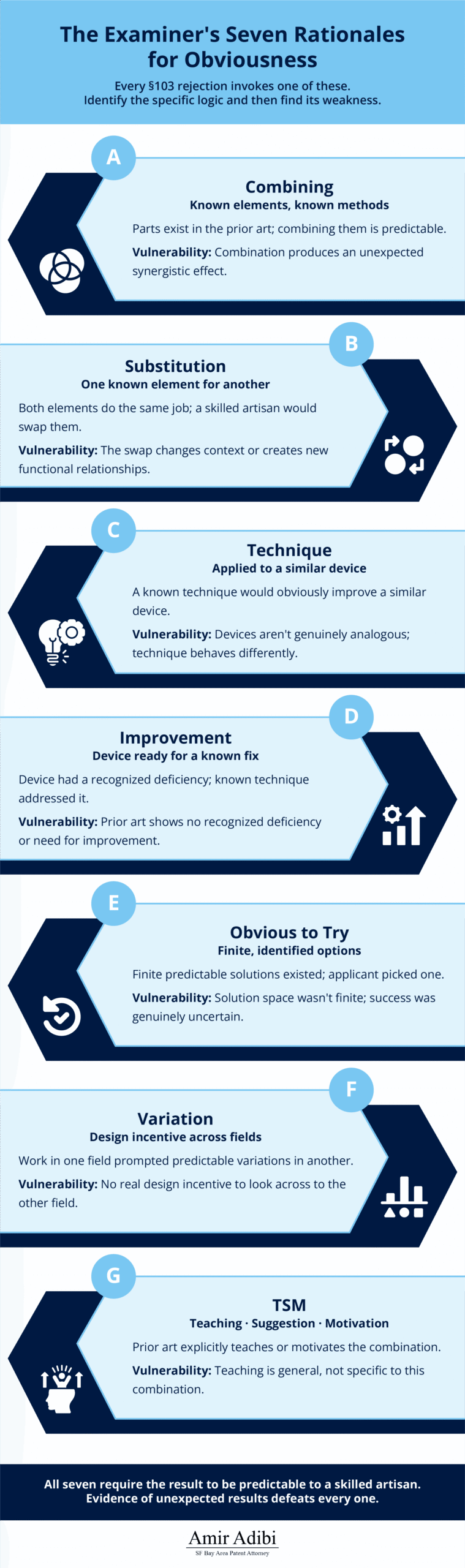
Each rationale below is a distinct logical argument the examiner can make. Understanding the structure of each one reveals where the argument is strongest and where it’s most vulnerable.
Rationale A: Combining Prior Art Elements According to Known Methods
This is the workhorse — the rationale examiners reach for most often. Rationale A applies when the examiner identifies separate elements of your claim across different prior art references and argues that combining them would yield predictable results.
The examiner must show that each claimed element existed in the prior art, that the combination would have been recognized by a skilled artisan as likely to succeed, and that the result is no more than the sum of the individual parts. The vulnerability sits in that last requirement. If your combination produces a synergistic or unexpected effect — something beyond what each component contributes individually — Rationale A weakens significantly. Check whether the examiner has established why a PHOSITA would bring these specific references together, rather than simply demonstrating that the individual pieces exist somewhere in the prior art. Finding the parts in separate drawers is not the same as showing someone would have assembled them.
Rationale B: Simple Substitution of One Known Element for Another
Rationale B applies when the examiner argues your invention merely swaps one known component for another in a known device or method, with predictable results. Replacing one type of fastener with another in a mechanical assembly. Swapping one well-characterized excipient for another in a pharmaceutical formulation. The word “simple” is doing heavy lifting here.
The examiner must establish that both elements perform the same function and that a PHOSITA would have recognized them as interchangeable. The strongest counter-argument targets that “same function” assumption. If the substituted element interacts differently with surrounding components — creating new functional relationships or solving a different problem — the substitution isn’t simple, and Rationale B breaks down. Pay attention to whether the examiner has addressed the context of the substitution, not just the identity of the swapped elements. A bolt and a rivet are both fasteners, but they create fundamentally different structural relationships.
Rationale C: Use of a Known Technique to Improve a Similar Device or Method
Where Rationale B swaps elements, Rationale C applies a technique. The examiner argues that a known technique used to improve one device or method would obviously be applied to improve a similar one, with predictable results.
The critical words are “similar” and “predictable.” The examiner must demonstrate that the base device and the device where the technique originated are sufficiently analogous that a skilled artisan would recognize the technique’s applicability. If your invention applies a technique from a distant or non-analogous field, or if the technique behaves differently in the new context, Rationale C is vulnerable. Scrutinize whether the examiner has established genuine similarity between the two contexts, or merely noted that the technique exists in one place and the device exists in another. Proximity on a library shelf is not the same as proximity in practice.
Rationale D: Applying a Known Technique to a Known Device Ready for Improvement
Rationale D is closely related to C but carries a subtly different burden. Here, the examiner argues that a known device was “ready for improvement,” a known technique existed to provide that improvement, and applying it would have yielded predictable results.
The “ready for improvement” element is the pressure point. The examiner must articulate why a PHOSITA would have recognized the device as needing or being amenable to that specific improvement, not just that the device could theoretically be made better. Everything can theoretically be made better. A recognized problem in the art that the technique addresses strengthens this rationale; the absence of any identified deficiency weakens it. If the prior art shows satisfaction with the existing device, or if the proposed “improvement” introduces tradeoffs the examiner hasn’t addressed, there’s room to push back.
Rationale E: “Obvious to Try” — Choosing from Identified, Predictable Solutions
Post-KSR, “obvious to try” became a legitimate basis for rejection — but it’s more constrained than many examiners and applicants realize. Rationale E requires the examiner to show a recognized problem or need in the art, a finite number of identified and predictable solutions, and good reason for a PHOSITA to pursue the specific option the applicant chose.
This rationale surfaces most often in pharmaceutical and biotech prosecution, where examiners argue that selecting a particular compound or target from a known group was obvious. The key defense: demonstrate that the “finite number of solutions” was neither as finite nor as predictable as the examiner assumes. If the field presented a sprawling landscape of possibilities, if success with any given option was genuinely uncertain, or if the applicant’s specific choice yielded unexpected results, Rationale E falters. The Federal Circuit’s In re Kubin (561 F.3d 1351, Fed. Cir. 2009) gives this rationale real teeth in biotech, but subsequent cases have reinforced that predictability of success — not just the ability to attempt — is what matters.
Rationale F: Known Work in One Field Prompting Variations in the Same or Different Field
Rationale F covers design incentive reasoning. The examiner argues that known work in one field of endeavor prompted design variations — either in the same field or a related one — and those variations were predictable to a PHOSITA.
This rationale often surfaces in software and mechanical arts where design choices branch predictably. The vulnerability lies in cross-field applications. If the examiner draws from a genuinely different field of endeavor without establishing why a PHOSITA in the applicant’s field would have looked there, the rationale lacks its required “design incentive” foundation. Watch also for whether the examiner has conflated “possible variation” with “predictable variation.” The fact that something could be varied doesn’t establish that a skilled artisan would have varied it in the specific way claimed.
Rationale G: Teaching, Suggestion, or Motivation in the Prior Art
Rationale G preserves the pre-KSR TSM approach as one valid rationale among seven. The examiner can still rely on an explicit teaching, suggestion, or motivation in the prior art to combine references — it’s just no longer the only permissible path.
When examiners invoke Rationale G, verify that the cited teaching actually supports the specific combination at issue, not just a general invitation to explore the relevant field. A reference that says “alternative approaches include…” does not necessarily teach the particular combination the examiner proposes. The suggestion must be specific enough to lead a PHOSITA toward the claimed invention with a reasonable expectation of success. General encouragement is not specific direction.
The Common Thread: Why Predictable Results Are the Linchpin
Strip away the labels, and every rationale rests on the same foundation: the examiner must establish that the result of the proposed combination, substitution, or modification would have been predictable to a PHOSITA. This isn’t procedural formality. It’s the conceptual core of the entire framework.
Predictability separates a legitimate obviousness finding from impermissible hindsight reconstruction. The examiner can point to known elements, known techniques, and known problems all day. But if combining them in the claimed way would have produced uncertain or unexpected outcomes from the perspective of someone working in the field at the time of invention, the prima facie case collapses.
This is where secondary considerations of non-obviousness become particularly powerful. Evidence of unexpected results — captured in the original specification, demonstrated through comparative testing, or supported by expert declaration — directly attacks the predictability requirement underlying every rationale. A practitioner who documents unpredictable results with specificity and rigor holds one of the most versatile tools against any §103 rejection, regardless of which rationale the examiner invokes.
What Must the Examiner Prove? Evidentiary Standards for Obviousness Rejections
The Examiner’s Burden: Articulated Reasoning with Rational Underpinning
A one-sentence obviousness rejection — “it would have been obvious to combine References X and Y” — is legally deficient. The examiner bears the initial burden of establishing a prima facie case, and MPEP 2143 specifies exactly what that burden requires. Four elements must be present: a factual finding for each claim element mapped to the prior art, identification of the specific rationale (A through G) being relied upon, an explanation of why a PHOSITA would have been motivated to arrive at the claimed combination, and an articulation of why the result would have been predictable.
The Federal Circuit has repeatedly vacated Board decisions where the fact-finder failed to provide the “reasoning with some rational underpinning” that KSR demands — as seen in cases such as In re Van Os (844 F.3d 1359, Fed. Cir. 2017). In practice, this means reading every §103 rejection with a mental checklist: Did the examiner identify the rationale? Did they explain the motivation? Did they address predictability? Any gap is a pressure point for your response.
One nuance matters here. The examiner is not required to show that a PHOSITA would have made the combination — only that a PHOSITA could have made it with a reasonable expectation of success. But “could have” still demands evidence and reasoning, not bare assertion. Conclusory statements are the hallmark of vulnerable rejections, and they remain surprisingly common.
Avoiding Hindsight Bias: The Examiner’s Obligation
The temptation is built into the process. The examiner reads the applicant’s specification, understands exactly what the invention does, and then searches for prior art that maps to the disclosed elements. By the time they write the rejection, they already know the answer. The challenge is proving they would have arrived at it without the roadmap.
The MPEP explicitly warns against this hindsight bias in patent examination, and practitioners can learn to spot its fingerprints. An examiner combining references from disparate fields without explaining why a PHOSITA in the applicant’s field would have looked to the other — that may be hindsight. A rejection relying on the applicant’s own specification to establish the motivation to combine — that’s textbook hindsight. An examiner selecting a narrow teaching from a broad reference, picking exactly the passage that maps to the claimed invention while ignoring the reference’s primary focus — that selective reading often signals reconstruction after the fact.
When challenging hindsight, frame the argument around what a PHOSITA would have known and done at the time of the invention, without the applicant’s disclosure serving as a guide. This temporal perspective is the foundation of every strong hindsight argument.
How to Respond to an Obviousness Rejection Under §103
Understanding the examiner’s framework is the diagnostic step. Now comes the intervention. Here’s how to systematically exploit gaps in a §103 rejection. For broader defensive prosecution strategies, contact our patent defense services.
Attacking the Examiner’s Rationale and Evidence
When a §103 rejection lands, resist the urge to argue the merits of your invention in the abstract. Instead, work through the examiner’s own framework methodically:
Step 1: Identify the specific rationale. Determine which of the seven MPEP 2143 rationales (A through G) the examiner invoked. If the office action doesn’t clearly specify one, that itself is a deficiency worth raising — the examiner is required to articulate reasoning within the framework.
Step 2: Verify the element mapping. Check whether every limitation in the rejected claim is mapped to a specific teaching in the cited prior art. Missing elements are often the simplest and most decisive gap. If even one limitation lacks a prior art counterpart, the prima facie case is incomplete.
Step 3: Evaluate the reasoning. Read the connecting logic between references. Has the examiner explained why a PHOSITA would combine them? Or is the reasoning conclusory — “it would have been obvious to one of ordinary skill” without substance behind it? Conclusory reasoning is legally insufficient.
Step 4: Assess teachings away. Determine whether any cited reference actually teaches away from the proposed combination. A reference that discourages, criticizes, or identifies problems with the examiner’s proposed approach directly undermines the motivation to combine.
Step 5: Check for hindsight. Evaluate whether the examiner has used the applicant’s own disclosure as the roadmap, selected elements from references with a precision that only makes sense given knowledge of the invention, or combined references from unrelated fields without justification.
Each step either confirms the examiner’s position or reveals a specific, articulable weakness you can target in your response. A daunting rejection becomes a structured analysis with identifiable pressure points.
Secondary Considerations of Non-Obviousness (Objective Indicia)
Even when the examiner’s prima facie case is technically sound, secondary considerations can overcome it. These aren’t supplementary arguments or extra credit — they can be dispositive. The Federal Circuit has held that objective indicia of non-obviousness must be considered as part of the overall determination, as established in Stratoflex, Inc. v. Aeroquip Corp. (713 F.2d 1530, Fed. Cir. 1983) and codified in MPEP §716.01(a).
The recognized categories: commercial success of the claimed invention (attributable to the claimed features, not marketing or brand recognition); long-felt but unsolved need the invention addresses; failure of others who attempted the same problem; unexpected results the combination produces; copying by competitors (implying the invention was not an obvious design choice); licensing activity indicating industry recognition; and skepticism of experts who doubted the approach would work.
Each carries a nexus requirement — the secondary consideration must be attributable to the claimed invention specifically, not to unclaimed features or external factors. Commercial success driven by a marketing campaign rather than the patented feature won’t carry weight. Build the evidentiary record connecting each consideration directly to the novel aspects of the claim.
The strongest arguments layer multiple categories. Unexpected results paired with failure of others, or commercial success coupled with initial expert skepticism, create a reinforcing narrative that’s difficult for the examiner to dismiss.
Declaration and Affidavit Evidence Under 37 CFR 1.132
When secondary considerations or unexpected results need formal evidentiary support, 37 CFR 1.132 declarations are the vehicle. A Rule 132 declaration is a sworn statement — typically from the inventor or a qualified expert — presenting evidence relevant to patentability.
The line between persuasive and ineffective often determines the outcome. A strong Rule 132 declaration for unexpected results includes comparative data between the claimed invention and the closest prior art, testing under conditions a PHOSITA would consider meaningful, an explanation of why the results were unexpected given the prior art’s teachings, and a statement of the declarant’s qualifications establishing their ability to evaluate significance.
A declaration that simply states “the results were unexpected” without comparative data or technical reasoning receives little weight. Make the showing specific and quantified. Where appropriate, include side-by-side data tables and statistical analysis that makes the unexpected nature of the results difficult to dispute.
Need help crafting a response to a §103 rejection? Get a strategy session with an experienced patent prosecutor.
Key Case Law Shaping MPEP 2143 and Patent Obviousness
KSR International Co. v. Teleflex Inc. — The Foundational Shift
The invention at the center of KSR v. Teleflex (550 U.S. 398, 2007) was almost unremarkable — an adjustable vehicle pedal assembly with an electronic sensor. But the Supreme Court used this modest mechanical patent to restructure how examiners, practitioners, and courts approach the entire §103 inquiry, correcting decades of doctrinal drift in the Federal Circuit’s obviousness jurisprudence.
The core holdings reshaped practice along several dimensions:
| Dimension | Before KSR | After KSR |
| Required Test | Rigid TSM — examiner needed explicit teaching, suggestion, or motivation in the prior art to combine references | Flexible, expansive inquiry — any reasoning with rational underpinning, including common sense and market forces |
| Role of Common Sense | Largely excluded — if the motivation wasn’t in the references, the combination wasn’t obvious | Expressly permitted — a PHOSITA is a person of “ordinary creativity,” not an automaton |
| “Obvious to Try” | Generally rejected as a basis for obviousness | Validated where solutions are finite and identified, with a reasonable expectation of success |
| Flexibility of Rationale | Essentially one path (TSM) | Seven enumerated rationales (A–G) in MPEP 2143, plus residual common sense |
| Examiner Burden | Narrow evidentiary requirement focused on prior art teachings | Broader reasoning permitted, but must still provide articulated reasoning — not mere conclusory statements |
The practical impact was immediate: examiners gained significantly more latitude to combine references, but they inherited the obligation to explain their reasoning within a structured framework. For practitioners, the post-KSR obviousness landscape demands engagement with the examiner’s specific rationale rather than a blanket argument that no TSM exists.
Federal Circuit Decisions That Refine the Framework
Several post-KSR Federal Circuit decisions have sharpened the boundaries of MPEP 2143’s rationales in ways practitioners should know:
Ortho-McNeil Pharmaceutical v. Mylan Laboratories(520 F.3d 1358, Fed. Cir. 2008): In unpredictable arts — particularly pharmaceutical chemistry — the “obvious to try” rationale faces a higher bar. Where complex biological interactions make outcomes genuinely uncertain, identifying a group of candidates does not make selecting the successful one obvious. Practitioner takeaway: In biotech and pharma prosecution, emphasize the unpredictability of the art and the number of alternatives the examiner’s logic would have required exploring.
Perfect Web Technologies v. InfoUSA(587 F.3d 1324, Fed. Cir. 2009): While the court upheld common sense as a basis for the missing step in this simple-technology context, subsequent decisions — particularly Arendi v. Apple (832 F.3d 1355, Fed. Cir. 2016) — established that common sense ordinarily cannot substitute for missing claim elements, especially where the missing limitation goes to the heart of the invention. Common sense may supply a motivation to combine, but using it to supply the elements themselves requires exceptional simplicity. Practitioner takeaway: If the examiner relies on “common sense” to supply a claim element rather than just a motivation, challenge the rejection as lacking factual basis — particularly when the missing element is central to the invention.
Wyers v. Master Lock(616 F.3d 1231, Fed. Cir. 2010): Validated the “obvious to try” approach where the field presented a limited number of design options, each with a predictable function. Trying different hitch pin lock configurations was obvious given the small design space. Practitioner takeaway: Counter “obvious to try” by demonstrating the design space was larger than the examiner characterized, or that the specific choice produced unexpected functional benefits.
In re Kubin(561 F.3d 1351, Fed. Cir. 2009): Upheld an obviousness finding for a gene-cloning invention where a known protein and known methodology made isolation predictable. The cloning techniques were well-established; the outcome followed. Practitioner takeaway: In biotech, the strongest defense against Kubin-style rejections is evidence the specific methodology didn’t work predictably — failed attempts, low yields, or unexpected sequence complications all undermine the “predictable results” foundation.
Practical Tips: Getting Ahead of Obviousness Rejections
Drafting to Preempt Obviousness Rejections
The best response to an obviousness rejection is one you never have to write. Thoughtful specification drafting can preempt the examiner’s strongest arguments before the first office action arrives.
Build unexpected results into the specification from day one. If your invention produces results a skilled artisan wouldn’t have predicted — better performance, unexpected synergies, solving a problem the prior art didn’t recognize — document that data or at least describe the surprising outcomes in the specification itself. You cannot easily introduce new evidence after filing, but evidence already in the record is available from the start.
Explicitly distinguish from the closest prior art. Don’t just describe what your invention does — explain what the prior art does differently and why your approach departs from the known path. This plants the distinction in the examiner’s mind before they begin their search.
Frame the problem your invention solves. Describe why existing approaches failed or fell short. This narrative creates a “long-felt need” foundation that supports both prosecution arguments and secondary considerations evidence if needed later.
Be deliberate about combination language. Avoid characterizing your invention as “combining” known elements or making a “simple modification” to existing technology. Language in the specification that mirrors an examiner’s rationale can become ammunition in the rejection. Words filed today become the examiner’s vocabulary tomorrow.
Define the PHOSITA. Establishing the level of ordinary skill in the art in the specification anchors the entire obviousness analysis. A properly defined skill level prevents the examiner from attributing unrealistic knowledge to the hypothetical artisan. As a strategic observation, in unpredictable arts a higher skill level may actually cut in the applicant’s favor — the more a skilled person appreciates the genuine uncertainty of outcomes, the less “obvious” a given combination becomes. This principle draws support from Federal Circuit precedent emphasizing that unpredictability undermines obviousness, as seen in Ortho-McNeil v. Mylan (520 F.3d 1358, Fed. Cir. 2008).
Strengthening Claims Against §103 Challenges
Claim drafting strategy directly shapes how susceptible your claims are to each rationale.
Draft claims that include limitations reflecting non-obvious structural or functional relationships between elements — not just the elements themselves. A claim to “A combined with B” is more vulnerable to Rationale A than “A configured to interact with B in a manner that produces [specific result],” because the latter requires the examiner to find not just the components but their claimed interaction.
Use dependent claims to capture unexpected synergies and specific embodiments that showcase non-obvious features. These provide fallback positions progressively harder for the examiner to reject. Claims at multiple levels of specificity give you negotiating room during prosecution without surrendering your broadest position prematurely.
Means-plus-function claim language can narrow the prior art comparison where structure, rather than function, distinguishes your invention. Under §112(f), these claims are interpreted by reference to the specification’s disclosed structure, making it harder for the examiner to map a generic prior art element to your specific limitation.
Engaging Effectively with the Examiner
Prosecution is a negotiation, and the examiner is your audience — not your adversary.
Request examiner interviews early. An interview after the first office action but before filing a formal response is often the most productive point of engagement. Examiners frequently reveal during interviews what specific evidence or argument would overcome the rejection — insight the written record alone won’t provide.
Ask the examiner to identify the specific MPEP 2143 rationale if the office action is unclear. This isn’t confrontational — it’s a legitimate procedural request that forces commitment to a specific analytical framework you can then target.
Submit Rule 132 declarations proactively when you have secondary consideration evidence. Don’t wait for the examiner to ask. Building the record early signals strength and often shifts the trajectory of prosecution.
Consider after-final practice options including advisory actions, pre-appeal brief conferences, and requests for continued examination. Each offers a different strategic posture. Pre-appeal brief conferences deserve particular attention — they bring a fresh pair of examiner eyes to the rejection and often result in reopened prosecution or agreement with the applicant’s position.
For managing these strategies across multiple patent families, patent portfolio analysis provides a broader framework for aligning prosecution tactics with business objectives.
Turning the Examiner’s Playbook to Your Advantage
MPEP 2143 is often treated as the source of an applicant’s problems — the section that arms examiners to reject inventions. Viewed from the other side, it’s a practitioner’s asset. The section is specific, structured, and bounded. The examiner must select a rationale, support it with evidence, articulate a logical connection, and establish predictability. Every one of those requirements is a potential gap in the rejection.
For patent prosecutors, this means precision over volume. Target the specific rationale the examiner invoked. Identify whether it’s Rationale A, C, or E — because the weaknesses of each are different, and a scalpel beats a shotgun in prosecution.
For startup founders navigating your first office action, this framework gives you a concrete basis for evaluating counsel’s response strategy. You can now ask: “Which rationale did the examiner use? What’s our specific argument against it?” That’s an informed conversation, not a blank check.
For independent inventors, a §103 rejection is not the end — it’s often the opening move in a productive exchange. But recognize when the examination raises issues that benefit from experienced counsel. The framework here helps you distinguish the straightforward rejections you might address yourself from the complex ones where professional guidance is worth the investment.
The examiner has a playbook: seven rationales, each with its own logic, each with its own vulnerabilities. Now you have it too.
Facing an obviousness rejection and need a clear path forward? Contact us to discuss your prosecution strategy.